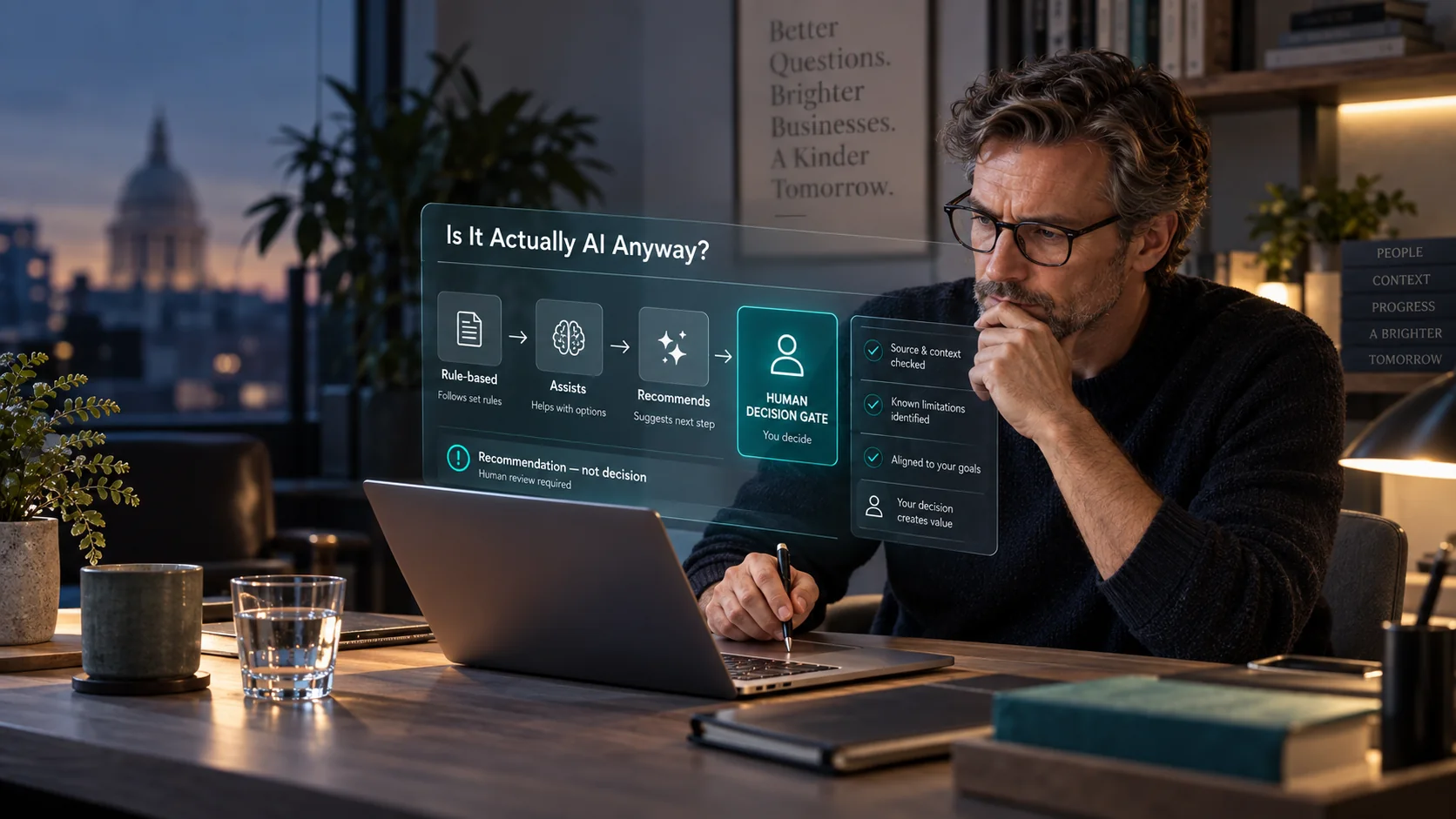
Or is it fancy automation dressed up as something more?
Everywhere you look, something is “powered by AI”.
Your inbox. Your CRM. Your customer service platform. Your accounting software. Your proposal tool. Your website chat widget. Your fridge, probably.
And I keep coming back to the same question:
Is it even AI?
Or is it fancy automation dressed up as AI because “powered by AI” sells better than “we made an old workflow a bit smoother”?
That is not me trying to be clever.
It is a serious question, because businesses are being sold a lot of things under the AI label right now. Some of them are genuinely useful. Some of them are intelligent in a meaningful sense. Some can interpret information, identify patterns, draft options, make recommendations and support better work.

And some of them are just automation.
A rule fires.
A workflow moves.
A message gets sent.
A field gets updated.
A lead gets routed.
None of that is automatically bad. Good automation has always been useful. It can remove repetition, reduce admin and stop good people wasting time on work a system could handle perfectly well.
But calling everything AI creates a problem.
Because the label changes how people behave.
When someone hears “automation”, they tend to ask practical questions:
What triggers it?
What does it do?
What happens if it fails?
Who can change it?
When someone hears “AI”, too often they stop asking those questions.
They assume it is cleverer than it is.
They assume it understands more than it does.
They assume it is making a judgement when it may only be following a pattern, a rule, a prompt or a workflow someone set up months ago and forgot about.
And that is where things get dangerous.
Not because automation is bad.
Not because AI is bad.
But because a business cannot govern something honestly if it does not understand what it has actually bought.
If it is automation, call it automation.
If it is an AI-assisted workflow, call it that.
If it is an AI Worker with a defined role, permission boundary, evidence source and human escalation route, then say so—and be able to show it.
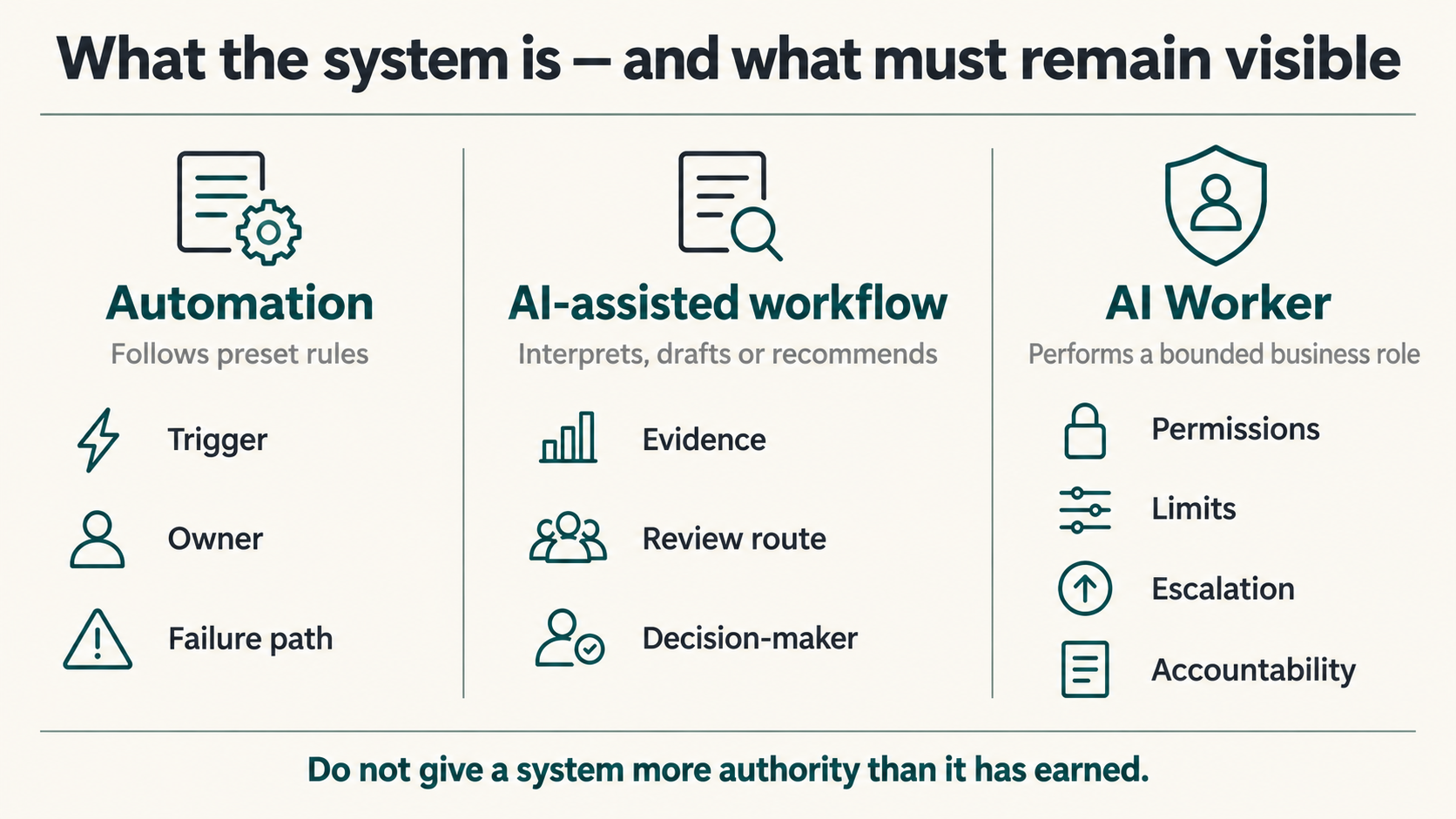
But do not hide a basic workflow behind the phrase “powered by AI” and expect people to hand over trust they would not otherwise give.
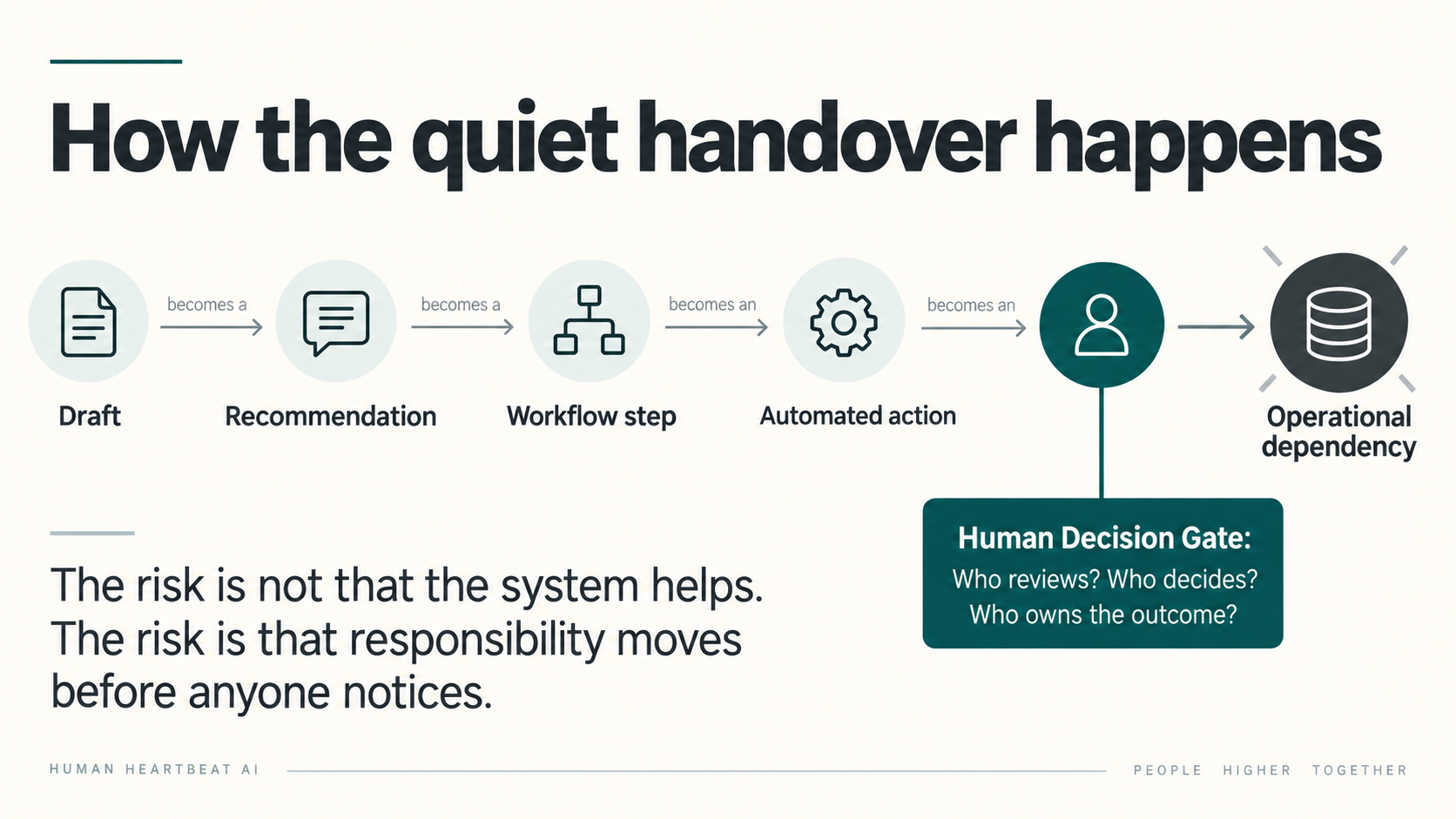
Because once the label becomes vague, authority becomes vague.
And once authority becomes vague, responsibility starts moving without anyone noticing.
The problem is not the tool
In my experience, many AI adoption problems do not begin because the model was not impressive enough. They begin because a business bought something before it understood its own operating position.
That is why I say the problem is not the tool. The sequence is the problem.
If you start with the tool, the tool starts defining the problem.
That is backwards.
A business under pressure is vulnerable to false clarity. If the founder is overloaded, if decisions are stacking up, if execution is unstable, if margins are leaking, if the team is permanently reactive, then any promise of speed sounds attractive.
So no, I am not interested in selling AI as a magic category.
I am interested in whether a business understands what is breaking, what must remain human, what can be supported, what can be bounded, and what should never be delegated without visible authority.
That is a different discipline.
What must remain human
Not every task needs a human hand on it at every moment. That would be silly. Good systems remove friction. Good automation saves time. Good AI can surface patterns, draft intelligently, structure messy information, help people think faster, and make useful work more accessible.
But there are things that must remain visibly human-owned.
Purpose.
Permission.
Judgement.
Escalation.
Accountability.
The authority to stop, override, challenge, or correct.

Those are not old-fashioned leftovers from a pre-AI world. They are the conditions that make trustworthy AI use possible.
That is the heartbeat in Human Heartbeat AI.
Not sentimentality. Not branding fluff. Not a soft-focus promise that technology should feel warm.
It means that where consequences are real, human responsibility must remain visible.
If a system is making recommendations that affect money, operations, people, service quality, customer relationships, or strategic direction, then someone must be able to say:
- What this system is doing.
- What it is not allowed to do.
- What evidence it relies on.
- Where its permissions end.
- Who reviews the output.
- Who decides.
- Who answers for the result.
If you cannot say those things, then you do not have a mature AI strategy.
You have a blind spot.
Why Human Heartbeat AI exists
Human Heartbeat AI was not built to chase the market with another “AI agency” slogan.
It exists because AI adoption done well requires clarity before tools, governance before automation, and human judgement before delegation.
That conviction is why the ecosystem exists in the shape it does.
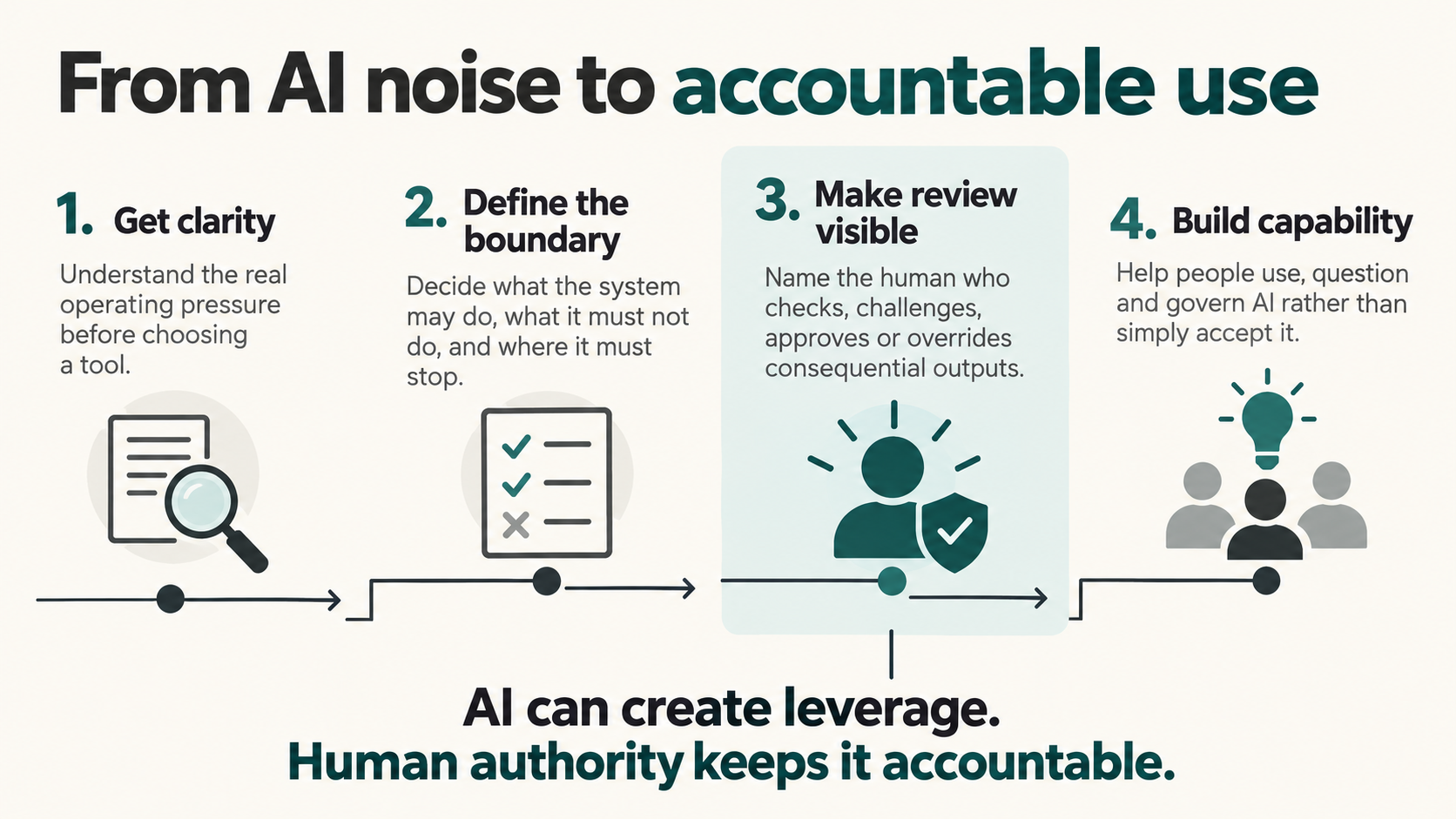
O.S.C.A.R. exists because businesses need more than noise. They need diagnosis. They need a structured way to understand the operating pressure before any tool is prescribed.
The governance work exists because permission, evidence, and accountability should not be implied. They should be designed.
Human Decision Gates exist because there must be a named point where a human can review, question, interrupt, or refuse a consequential AI-supported action.
AI Workers exist because if AI is going to operate inside a business, it should do so in a bounded role, not as an undefined promise of autonomy.

The Academy exists because capability is not built by throwing people at tools and hoping they cope. It is built by helping people understand what they are working with, what they are responsible for, and how to think clearly in the middle of technological pressure.
The Founder’s Notes and AI Breaking Stories exist because this cannot stay as a static philosophical position. It has to be tested against the world as it changes.
So no — these are not separate products pretending to be an ecosystem.
They are different responses to the same underlying problem:
the quiet handover of human responsibility to AI-shaped systems without sufficient clarity, governance, or conscious consent.
What I believe
I believe businesses should use AI.
I believe they should learn it, test it, challenge it, and benefit from it.
I believe some work can and should move faster because of it.
I believe some decisions can be better informed because of it.
I believe some operational strain can be reduced because of it.
But I do not believe any business should be rushed into handing over judgement just because the market is noisy and the software is persuasive.
I do not believe “AI-powered” is a meaningful claim on its own.
I do not believe automation without accountability is progress.
I do not believe a founder, team, school, or organisation becomes more intelligent by making its own boundaries invisible.
And I do not believe the answer to pressure is to surrender the part of the business that still requires human explanation, informed judgement and accountable decision-making.
That is the line.
The standard
So when I ask, “Is it actually AI anyway?”, I am not just asking for a technical classification.
I am asking a harder question.
What is this thing being allowed to influence?
What authority has it been given?
What dependency is being created?
Who understands it?
Who can stop it?
Who owns the outcome?

That is the standard I think businesses need now.
Use AI, yes.
Build with it, yes.
Let it remove friction where it genuinely should.
But do not allow it to quietly remove understanding, ownership, judgement, or responsibility from the people who will still be left carrying the consequences.
That is the backbone.
That is the spine.
That is what Human Heartbeat AI is hung from.