I keep seeing the same mistake. People get excited about AI Workers and immediately ask the wrong question. They ask: What can it do? Can it write emails? Can it chase leads? Can it answer customers? Can it book meetings? Can it update records? Can it make recommendations? Can it run the workflow while I sleep? And I understand why they ask that. Because capability is seductive.
It feels like progress. It feels like leverage. It feels like finally getting the support you always needed but could never afford. As a founder, I feel that pull as much as anyone. I know what it is to look at a business and think, "If only I had another pair of hands." I know what it is to carry too many decisions, too many tasks, too many open loops, and wonder whether AI could take some of the weight.
Of course it can. That is not the question that worries me. The question that worries me is this: What will your AI Worker never be allowed to do? That is where the real governance begins. Not in the feature list. In the forbidden list. Because if you only define what an AI Worker can do, you have not governed it. You have advertised it to yourself. You have built the excitement layer, not the control layer.
And that is dangerous. An AI Worker is not just another piece of software. It is not a spreadsheet. It is not a calculator. It is not a filing cabinet with a nicer interface. An AI Worker can interpret. It can prioritise. It can draft. It can recommend. It can route. It can escalate. It can summarise. It can make one thing look more important than another.
And once it starts doing that, it is no longer sitting quietly at the edge of the business. It is moving toward judgement. That is the line. That is the place where I slow down. Because I am not afraid of AI being useful. I am afraid of AI being useful enough that people stop noticing how much authority they are giving it. One day it is helping. Then it is suggesting. Then it is preparing. Then it is ranking.
Then it is deciding what reaches your desk and what does not. And before anyone has made a conscious decision to hand over control, the business is already moving differently. That is why I do not start with autonomy. I start with refusal. What must this AI Worker refuse to do? What must it never send? What must it never approve? What must it never change? What must it never promise? What must it never decide?
What must it always bring back to a human? That is not fear. That is responsibility. And if that sounds heavy, good. It should. Because AI optimisation is bloody scary if you do not know what is being optimised. People talk about optimisation as if it is automatically good. Optimised for what? Speed? Conversion? Engagement? Revenue? Convenience? Lower cost? Fewer human interruptions? A smoother workflow?
A faster answer? Because those things may be useful. But they are not the same as judgement. They are not the same as trust. They are not the same as doing the right thing for the customer, the team, the supplier, or the business five steps down the line. If you do not define the purpose, the system will optimise around whatever it can measure.
And if you do not define the boundaries, it may optimise away the very friction that kept you safe. That pause before sending. That awkward question. That human hesitation. That "something does not feel right." That is not inefficiency. Sometimes that is the heartbeat. A business without those pauses is not necessarily more advanced. It may just be more exposed. This is why I push so hard on the Human Decision Gate.
Not because I want to slow everything down. Not because I want to bury small businesses in policy. Not because I think AI Workers should sit in a cage doing nothing useful. The opposite. I want AI Workers to be genuinely useful. I want them to take pressure off good people.
I want them to prepare work, surface evidence, reduce repetition, find patterns, draft options, highlight risk, and make better use of the knowledge already inside a business. But I do not want them quietly becoming the business. I do not want a founder waking up six months later and realising the AI Worker has learned the rhythm of the company better than the company understands itself.
I do not want teams becoming passive approvers of outputs they no longer understand. I do not want customers receiving decisions shaped by a system nobody can explain. And I do not want business owners mistaking a smooth workflow for a governed one. That is the trap. Smooth does not mean safe. Fast does not mean right. Automated does not mean accountable. And intelligent-sounding does not mean authorised.
That last word matters to me. Authorised. Who authorised the AI Worker to do that? Who defined its limits? Who checked what it was optimising for? Who decided what evidence it could use? Who said where it must stop? Who owns the consequences when it gets it wrong? If the answer is vague, the business is already in trouble. Not because the AI is evil. Because the authority is unclear.
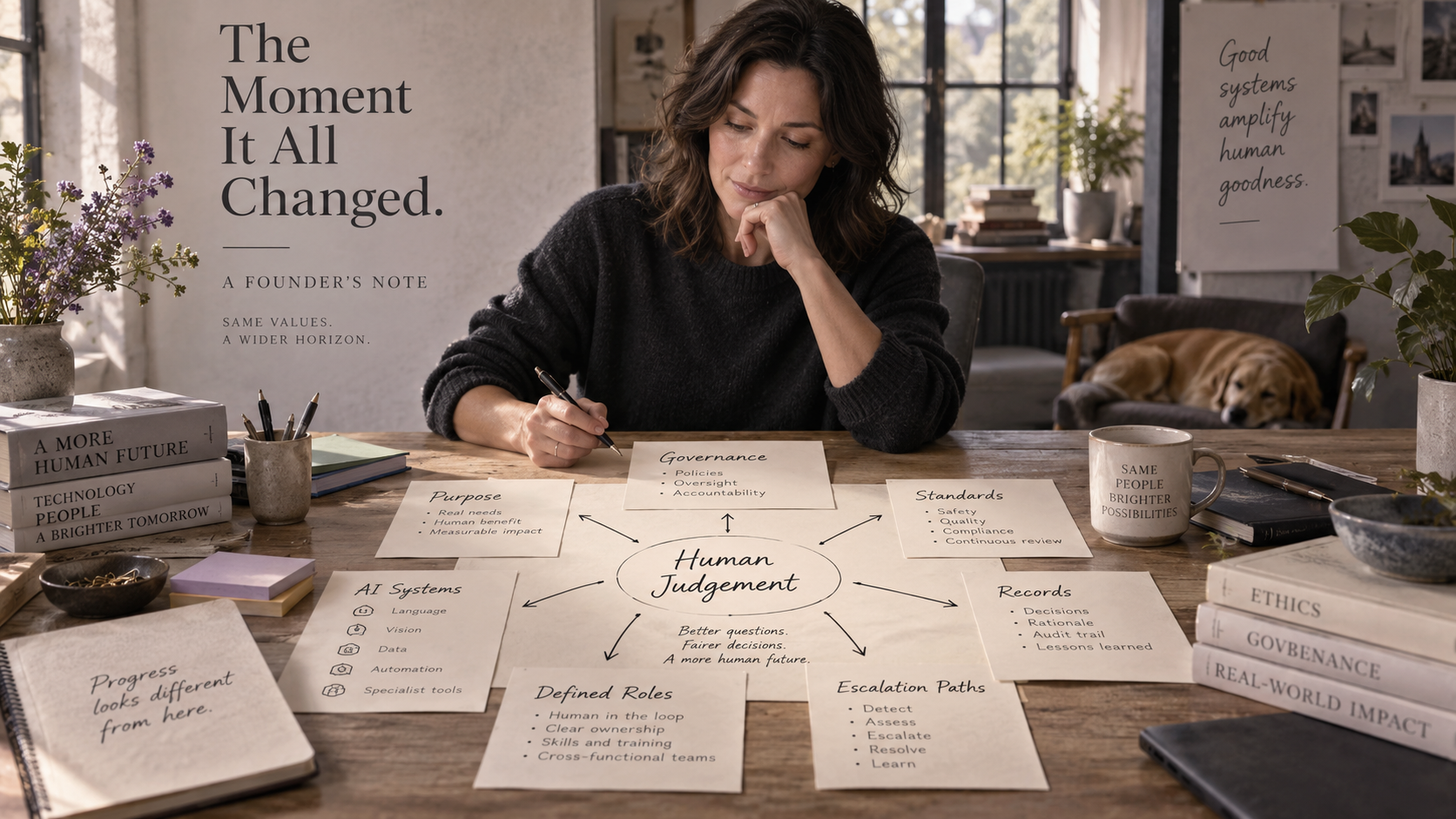
And unclear authority is where quiet surrender begins. So my view is simple. Do not build an AI Worker by asking how far it can go. Build it by deciding where it must stop. Then make that boundary visible. Make the refusal visible. Make the escalation visible. Make the evidence visible. Make the Human Decision Gate visible. If an AI Worker drafts a customer response, the human must know what it used and why.
If it ranks a lead, the human must know what signals shaped that ranking. If it prepares a renewal, the human must know what assumptions sit underneath it. If it recommends a supplier, the human must know what it weighted and what it ignored.
If it touches money, customers, staff, suppliers, reputation, operations or trust, it must not be allowed to glide past human judgement just because the interface looks confident. That is not anti-AI. That is how you keep AI useful. That is how you let it work without letting it take the wheel. And that is why, for me, the most important question about any AI Worker is not: What can it do? It is:
What will it never be allowed to do? Because capability without boundaries is not intelligence. It is exposure. And if you do not decide the limits before the system starts moving, do not be surprised when one day you look up and ask the question no founder wants to ask: Who is actually running this business?
Pass the argument to someone who should be part of it.
Continue through the Founder Notes series.