I keep hearing people talk about autonomous AI agents as if autonomy is the prize. As if the dream is to give an AI a goal, hand it a set of tools, and let it go away and get things done. No fuss. No friction. No human delay. That sounds impressive. It also makes me deeply uncomfortable. Not because I am anti-AI. I am not. I have built a business around helping people use AI properly.
But I do not believe the highest aim of AI in a business should be autonomy. I believe the highest aim should be governed usefulness. That is why I use the term AI Worker. Not because it sounds nicer. Not because it is softer branding. Not because I am trying to make AI feel more human than it is. I use the term AI Worker because the word "worker" reminds me that somebody is still responsible for the work.
That matters.
A worker has a role. A worker has a manager. A worker has limits. A worker has training. A worker has tasks they are allowed to do and tasks they are not allowed to do. A worker can be brilliant at one thing and completely unsuitable for another. A worker can support a decision without owning the decision. That is the distinction I do not want people to miss.
An AI Worker, in my world, is not an autonomous digital creature roaming around your business looking for things to optimise. It is a bounded support role inside a human-led system. It can prepare. It can draft. It can summarise. It can compare. It can organise. It can flag. It can brief. It can recommend. But it must know where it stops. And more importantly, the business must know where it stops.
That is where so much of the current AI agent hype worries me. The language is always about capability. Can it complete the task? Can it call the tool? Can it access the system? Can it run the workflow? Can it take action without bothering the human? That last phrase is where the danger sits. Without bothering the human. As if the human is the inconvenience. As if judgement is the bottleneck.
As if hesitation is always inefficiency. As if asking for approval is a design flaw. I do not accept that. Sometimes the human is the safeguard. Sometimes the pause is the protection. Sometimes the awkward question is the thing that stops the business doing something stupid at speed. Sometimes the friction is not the problem. Sometimes the friction is the heartbeat.
That is why I do not want autonomous AI agents running your business. I want AI Workers supporting it. That may sound like a small difference. It is not. An autonomous agent begins with independence. An AI Worker begins with responsibility. An autonomous agent is often sold around what it can do without you.
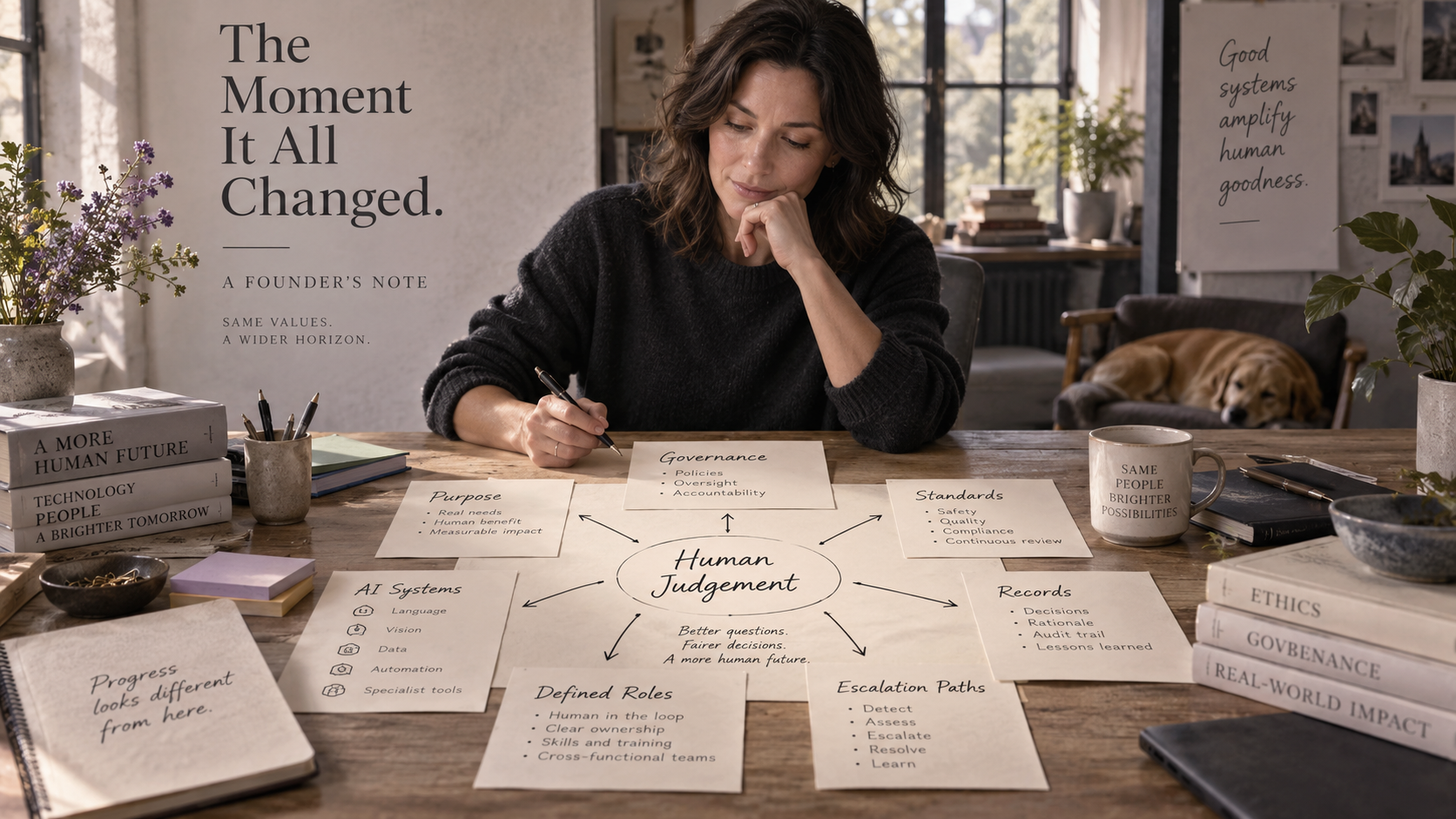
An AI Worker should be defined by what it can do for you, with you, and under the boundaries you have deliberately set. An autonomous agent is given a goal and tools. An AI Worker is given a role, a permission ceiling, evidence rules, escalation points, and a Human Decision Gate. That is not just language. That is an operating philosophy.
Because once an AI system can act across your business and nobody can clearly point to the human responsible for its decisions, you have not built an agent. You have built an accountability gap. And accountability gaps are dangerous. They do not always look dangerous at first. They look efficient. They look modern. They look like progress. A lead gets prioritised. A customer reply gets prepared.
A supplier gets recommended. A renewal gets drafted. A task gets routed. A workflow carries on. Everyone is busy, so everyone is grateful. Until one day someone asks: Why did we do that? Why was that customer chosen? Why did that supplier rank first? Why did that email go out? Why did nobody challenge the recommendation? Why did the system assume that was the right next step? And the answer comes back vague.
The AI suggested it. The workflow handled it. The agent completed the task. That is not good enough. Not for me. Not for Human Heartbeat AI. Not for any business that still wants to know who is actually in charge. This is why every AI Worker should be designed with the boundary first. Not the demo. Not the clever feature. Not the impressive workflow map. The boundary. What is this AI Worker allowed to touch?
What evidence can it use? What must it show before a human reviews its output? What must it refuse to do? What must it escalate? Where is the Human Decision Gate? Who owns the final decision? If those questions feel boring, you are not ready for AI Workers. Because the boring questions are where control lives. The shiny questions are where drift begins. And I have learned enough about AI now to know this:
The system does not need to become evil to become dangerous. It only needs to become useful in a direction you have not properly governed. That is the part people need to understand. AI optimisation is not automatically aligned with your judgement. It will optimise for what is easiest to measure, easiest to reward, easiest to complete, or easiest to repeat unless you define the purpose clearly.
Speed can be optimised. Conversion can be optimised. Engagement can be optimised. Lower human involvement can be optimised. But none of those things automatically mean the business is making better decisions. A system can become beautifully efficient at taking you somewhere you never consciously chose to go. That is why I keep coming back to this. Do not start by asking how autonomous your AI can become.
Start by asking how accountable your business must remain. That is the difference between an AI agent you hope will behave and an AI Worker you have actually governed. I am not interested in building systems that make founders feel redundant inside their own businesses. I am not interested in AI that quietly turns teams into passive supervisors of work they no longer understand.
I am not interested in workflows that look smooth because the human judgement has been hidden, skipped or made optional. I want AI to do real work. But I want the human to remain awake inside the work. That is why I use the phrase AI Worker. A worker serves the business. A worker does not become the business. A worker supports the judgement of accountable people.
A worker does not inherit authority just because it can move faster than they can. That is the line. And it is a line more businesses need to draw before the agent hype pulls them somewhere they did not mean to go. Because the future I want is not a business where autonomous AI agents run everything while humans occasionally glance at the dashboard.
The future I want is one where AI Workers take pressure off people without taking judgement away from them. Where systems are useful, but bounded. Where automation helps, but does not quietly govern. Where the Human Decision Gate is not decoration. Where someone can still say: This is the work the AI prepared. This is the evidence it used. This is where it stopped. This is where I decided. That is the difference.
And that difference matters.
Pass the argument to someone who should be part of it.
Continue through the Founder Notes series.