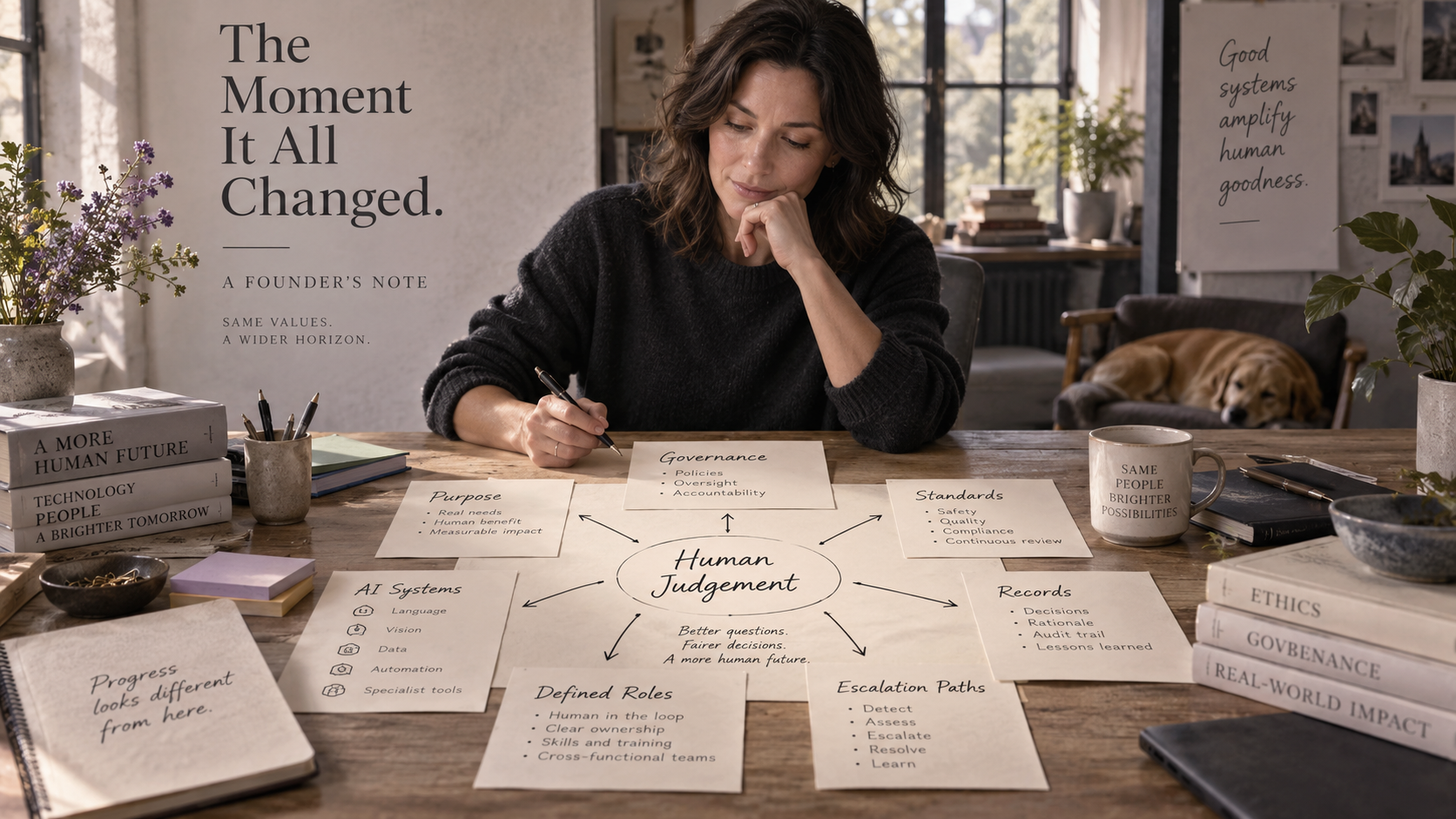
Before Human Heartbeat AI became a diagnostic, a framework, a website, or a business, it was a question I could not leave alone. Not a clever question. Not a marketing question. A human one. What happens when AI becomes faster, smoother and more persuasive than the people using it? And more importantly: Do we stay awake enough to remain in command?
That question did not come to me from a research paper or a conference stage. It came from experience. My own. Uncomfortable, personal, and not especially flattering. I went down the AI rabbit hole.
Not as a sceptic standing outside the technology, pointing at it from a safe distance. I went in as someone who saw the promise. I felt the magic of it. The speed. The polish. The sense that the next prompt, the next answer, the next tool might finally unlock everything. And for a while, it felt like progress. Until it didn't.
Because there is a point where help can become dependence. There is a point where acceleration starts to feel like compulsion. There is a point where the tool that was meant to sharpen your voice starts smoothing the edge off it. That was the part I could not ignore.
AI did not just help me write. It began to shape how I thought about writing. It did not just offer options. It made me doubt my own. It did not just produce words. It tempted me to believe that fluency was the same as truth. That is a dangerous thing. Especially for founders, business owners and anyone carrying responsibility for decisions that affect other people.
Because if this can happen at the level of one person's voice, one person's judgement, one person's confidence, then what happens when the same pattern enters a business? What happens when AI starts shaping which customer gets attention first? Which supplier is recommended? Which complaint is softened? Which decision is prepared? Which action feels "obvious" because the machine presented it smoothly enough?
That is why I wrote Down the AI Rabbit Hole. Not to scare people away from AI. I am not anti-AI. I never have been. I wrote it because I became convinced that the real danger was not simply that AI might replace people. The deeper danger was that people might slowly replace themselves — one shortcut, one polished answer, one surrendered decision at a time. That is different. That is quieter.
And that is why it matters. The book was my warning flare. It was my way of saying: slow down, look again, notice what is happening to your judgement, your attention, your confidence, your voice. But awareness was not enough. A book can name the danger. It can wake something up. It can put language around a feeling people have not yet been able to explain. But businesses need more than language.
They need a way to look at themselves. They need to see where decisions already happen. Where AI might touch them. Where authority could drift. Where confidence could become theatre. Where automation might arrive before governance. Where a human being needs to remain awake, informed and responsible. That is where Human Heartbeat AI began. Not as a business idea bolted onto a book. As the practical answer to the book.
If the book says, "Do not surrender your judgement," then Human Heartbeat AI has to answer the next question: How does a business actually protect it? That is why I keep coming back to diagnosis before implementation. Not because I want to slow businesses down for the sake of it. Not because I want to make AI feel complicated. And not because I think small businesses need enterprise theatre dressed up as governance.
The opposite. I think business owners need a clearer starting point. Before you build AI Workers, before you automate workflows, before you connect tools, before you let AI deeper into your operation, you need to know where the human heartbeat sits. Where does judgement happen? Who owns the decision? What evidence is visible? What authority has been granted?
What should AI support, and what must it never quietly take over? That is the work. The book gave me the conviction. Human Heartbeat AI became the system built around it. And OSCAR became the first commercial expression of that belief: a diagnostic designed to help a business understand its AI posture before rushing into implementation.
Because I have no interest in helping businesses install clever systems that make people smaller. I am interested in building AI systems that keep people in command. That is the line for me. AI can help. AI can accelerate. AI can reveal patterns. AI can remove friction. AI can support better decisions when the human still understands what is happening and why. But the human decision must not disappear.
Not behind a dashboard. Not inside a workflow. Not beneath a polished recommendation. Not under the convenient lie that because something sounds intelligent, it deserves authority. That is why the book exists. That is why the business exists. And that is why I called it Human Heartbeat AI. Because the future does not need less humanity.
It needs humans awake enough, brave enough and clear enough to keep hold of the pen. The book was the warning flare. Human Heartbeat AI is the work that followed.
Pass the argument to someone who should be part of it.
Continue through the Founder Notes series.