I keep having three separate conversations. They happen with founders, teams, people who build AI, people who sell it, and people who are simply trying to work out whether they are being sensible or left behind. On the surface, they sound different. One is about autonomous agents. One is about authority. One is about the strange, quiet way we can start giving our thinking away.
But the more I have them, the more I think they are the same conversation from three angles.
The conversation about autonomous agents
The first one became I Don’t Want Autonomous AI Agents Running Your Business. I was not arguing that AI should sit in a corner and never do anything useful. That would be ridiculous. AI can prepare, organise, draft, analyse, spot patterns and take real weight out of people’s day.
The question is simpler than that: what happens when useful help becomes permission to act, and nobody has stopped to say where the line is? I do not want an AI agent quietly taking ownership of a business just because it is quick, fluent and available at 2 a.m. I want a person to remain responsible for the moments that matter.
The conversation about the missing layer
The second one became The Missing Layer Between Human Authority and AI Action. This is the practical bit people often skip. They say, “A human is in the loop,” as if that settles it. But which human? With what information? At what moment? With the genuine ability to say no, not yet, show me why, or stop?
That is why I keep coming back to the Human Decision Gate. Not as a bureaucratic ceremony, and not as a box somebody ticks after a machine has already made the real call. It is the visible point where evidence, authority and consequence meet—and where a named human being still decides what happens next.
The conversation about quiet surrender
The third one became The Real AI Risk Is Not Replacement. It Is Quiet Surrender.. This is the one that gets closest to the human side of all of it. Most of us will not wake up one morning and formally hand our judgement to an AI system. It happens in smaller, more comfortable moves.
We accept the first recommendation because it saves time. Then the next one because it sounds sensible. Then, eventually, we stop noticing the difference between a system helping us think and a system doing the thinking for us. Nobody has to force that handover. Convenience does the work quietly.
“You do not need three separate frameworks. You need one way of working that holds all three truths at once.
They are one foundation
That is the connection. If you let an AI act without a visible authority boundary, you make quiet surrender easier. If you say a human remains in charge but cannot point to the decision, the evidence or the stop point, you have not really kept human authority. And if you notice the quiet surrender but do nothing practical with that insight, you are left with a good warning and no operating model.
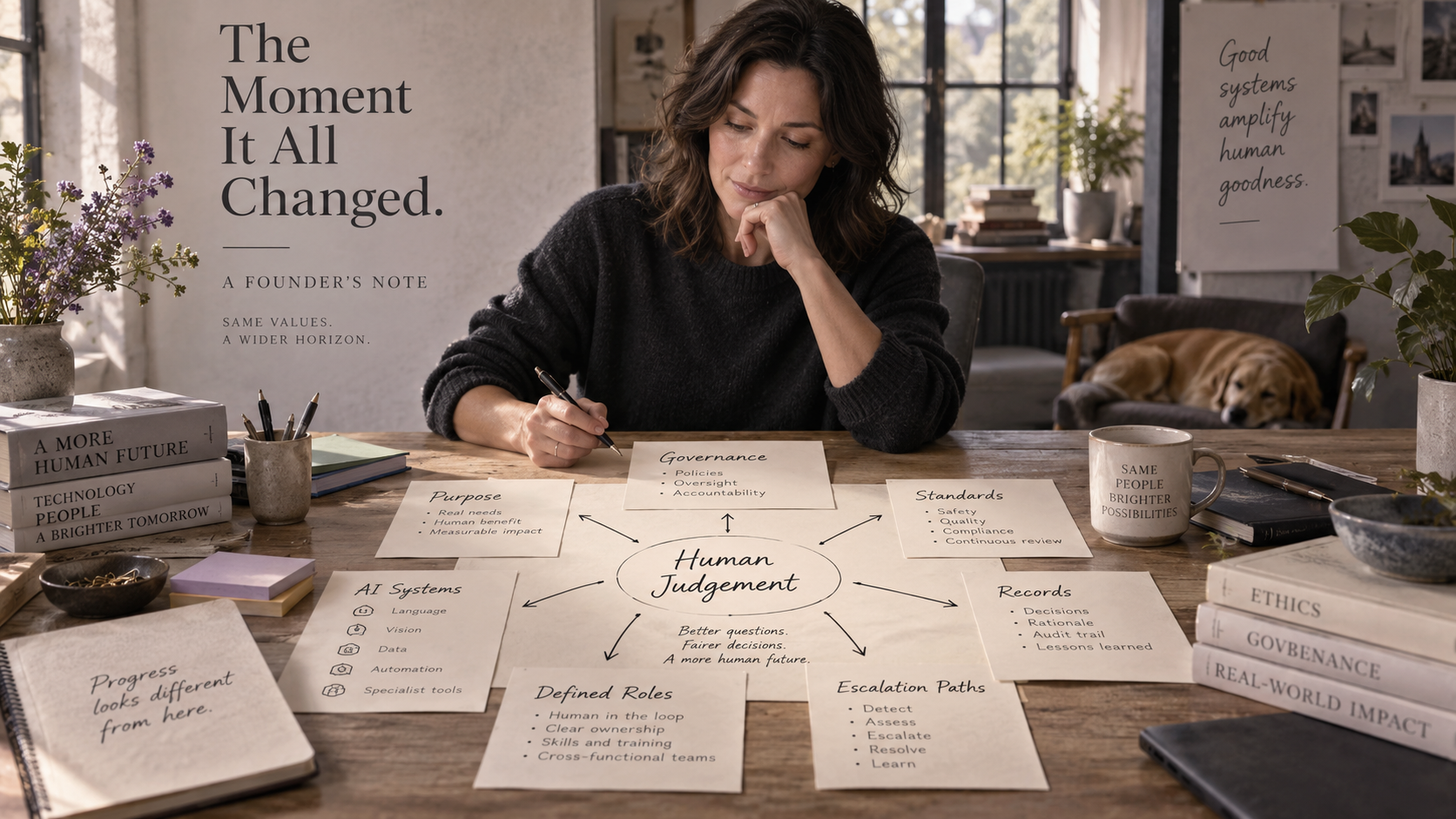
Most AI adoption is fragmented. One team buys a tool. Another writes a policy. Somebody adds an approval step. Somebody else worries that the culture is moving too fast. Each concern is real, but they are usually treated as separate jobs. I do not think they are. They are three legs of the same foundation: what AI may do, what a person must still decide, and how we stay awake enough to notice when the boundary starts moving.
How Human Heartbeat AI holds them together
This is why Human Heartbeat AI is built the way it is. Robbie is not there to take responsibility away from people. Robbie is there to support reflection, accountability and the conversations that can otherwise get missed when everything is moving quickly. The Human Decision Gate is there to keep consequential progression and authority with the responsible human. And the wider governance structure is there to make the permissions, evidence and limits visible before they become a problem later.
None of that makes AI less useful. It makes its usefulness easier to trust. It gives a business somewhere firm to stand while it decides where AI belongs, what it is allowed to help with, and where the human being stays unmistakably in charge.
This is a step forward
For me, this is a step forward in how businesses think about AI. Not because it gives them another framework to download and forget. Because it joins the questions up. It says that autonomy, authority and awareness belong in the same conversation from the beginning.
That is what is different about Human Heartbeat AI. We are not asking businesses to choose between moving forward and staying human. We are building a way to do both—with real boundaries, real responsibility and a human heartbeat still present at the point of consequence.
— Phil
Pass the argument to someone who should be part of it.
Continue through the Founder Notes series.