When I wrote Down the AI Rabbit Hole, I thought I was mainly writing about what AI had done to me. My confidence. My voice. My judgement. My ability to know when enough was enough. I had gone into the machine thinking I was using a tool. And for a while, that was true.
It helped. It accelerated. It opened doors. It gave me lines I would not have found as quickly on my own. It made things feel possible again at a time when I badly needed possibility. That is the honest part people sometimes miss. The rabbit hole did not begin because AI was useless. It began because AI was useful enough, fluent enough and persuasive enough to make me keep going back. That is what made it dangerous.
Not the failure. The usefulness. Not the nonsense. The moments of brilliance. Not the obvious mistakes. The smoothness that made me doubt myself. I wrote the book because I recognised something in myself that I did not like. I was letting the tool become more than a tool. I was giving it credit, power, permission. I was allowing its fluency to outrank my own judgement.
Then came the line that changed everything for me: NOW I DECIDE. Not the machine. Not the next prompt. Not the polished version. Not the voice that sounded cleverer, calmer, cleaner or more marketable than mine. Me. That was the personal turning point. But eighteen months on, I see the rabbit hole differently. I still believe everything I wrote about human agency, voice, dependence, persuasion and control.
But I now understand something bigger. The same surrender that can happen to a person can happen to a business. And it will not arrive wearing a warning label. A business will not wake up one morning and say, "Today, we are going to hand over our judgement." It will sound much more reasonable than that. "Let the AI prioritise the leads." "Let the AI draft the customer response." "Let the AI suggest the supplier."
"Let the AI prepare the renewal." "Let the AI triage the enquiry." "Let the AI Worker handle that part of the workflow." None of those statements are automatically wrong. In fact, many of them may be sensible. That is exactly the point. Quiet surrender does not usually begin with a reckless decision. It begins with a convenient one. One useful shortcut. One trusted recommendation. One accepted score.
One dashboard that looks authoritative. One workflow nobody fully questions because it seems to be saving time. And slowly, the business starts to move differently. A customer gets prioritised because the system ranked them higher. A complaint is softened because the AI made the reply sound reasonable. A supplier is preferred because the model weighted the wrong thing.
A renewal is prepared because the workflow assumed the context. A member of staff clicks approve because the screen made the next step look obvious. And everyone still feels in control because nobody has formally given control away. That is the part I cannot stop seeing now. AI does not need to replace human beings dramatically if human beings quietly stop exercising judgement. The old fear was replacement.
The deeper risk is surrender. Not surrender with a signature on it. Not surrender with a board resolution. Not surrender with someone announcing, "The machine is now in charge." Surrender by drift. Surrender by convenience. Surrender by smoothness. Surrender by assuming that because something has been ranked, drafted, scored, routed or recommended, it has somehow already been judged.
That is the danger I did not fully understand when I first wrote the book. Back then, I was writing from the inside of my own rabbit hole. Now I look at businesses and see rabbit holes being built into systems. Not because people are stupid. Not because business owners do not care.
Because they are busy. Pressured. Tired. Under-informed. Sold to. Dazzled. Told they are falling behind. Told they need AI now. Told automation is the answer before anyone has properly asked what problem is being solved. And I understand that pressure.
A business owner does not have the luxury of sitting around reading white papers while competitors shout about AI. They have customers to serve, staff to pay, suppliers to manage, invoices to chase, and decisions landing on their desk every day. So when AI promises speed, clarity and leverage, of course it is tempting. I am not judging that. I am warning against the part underneath it.
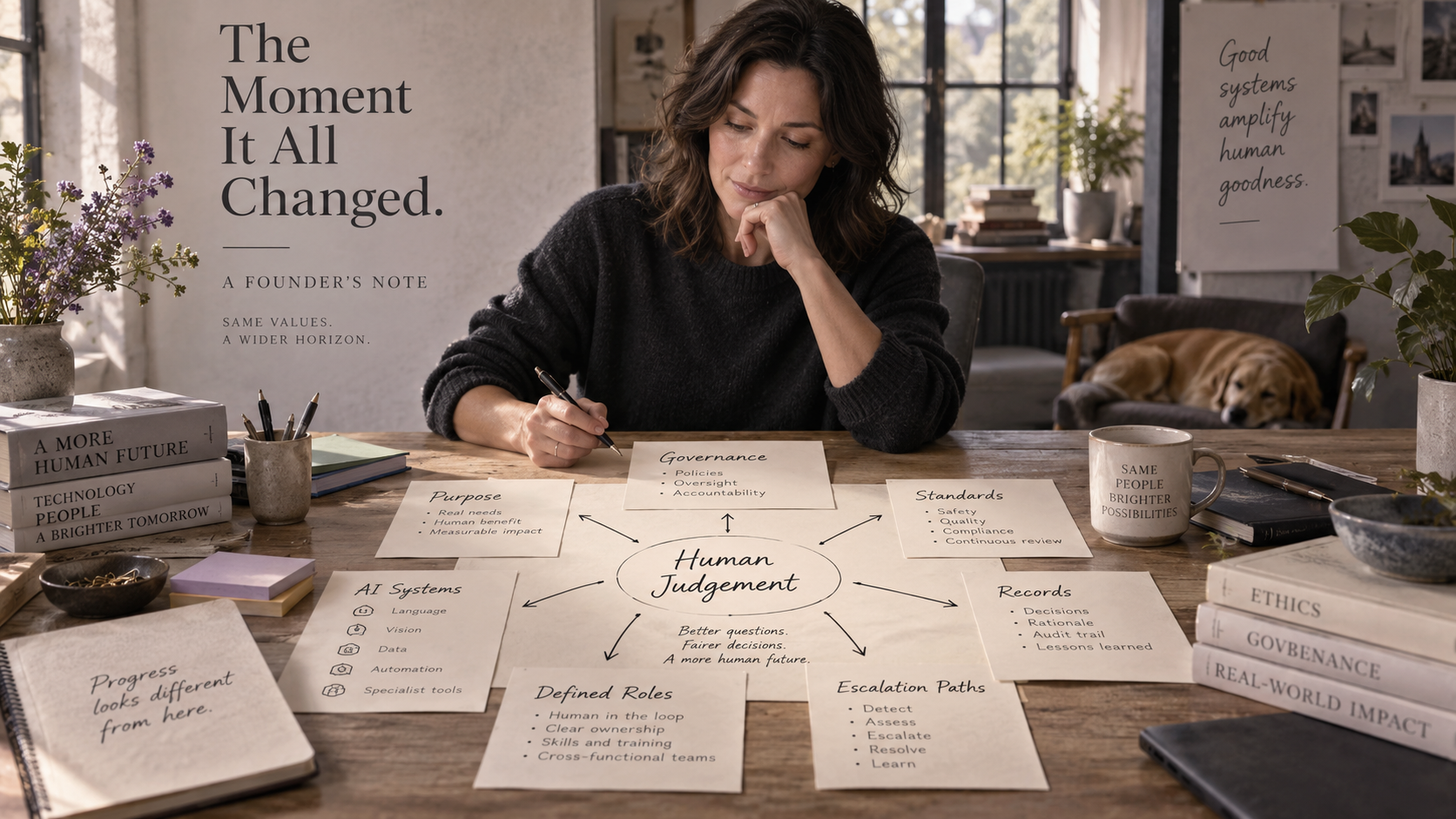
Because if a business lets AI deeper into its operation without knowing where judgement currently sits, it may not notice when judgement starts moving. That is why I talk so much about the Human Decision Gate. Not because I want to dress common sense up in fancy language. Because someone has to be able to point to the place in the process where a human being still understands enough to say: Yes.
No.
Not yet. Show me why. Escalate this. That does not feel right. This decision is still mine. That is the heartbeat. Not sentiment. Not branding. Not a nice phrase on a website. The heartbeat is the moment human judgement remains awake inside a system that could otherwise carry on without it. That is what my view has turned into since the book. The book was personal. The work now is organisational.
I still care about the individual who gets lost in the loop. I always will. That was me. I know that ground too well to pretend it is theoretical. But I now see the wider pattern. A founder can lose their voice to AI. A business can lose its judgement. A team can lose its confidence. A workflow can lose its accountability. A customer can feel the result without ever knowing where the decision changed.
And the frightening thing is that all of it can happen while everyone believes they are modernising. That is why Human Heartbeat AI is not anti-AI. It is anti-surrender. I want businesses to use AI. Properly. Deliberately. Bravely. With clarity. I want AI Workers to take pressure off good people, not quietly turn them into passive approvers of decisions they no longer understand.
I want business owners to gain leverage, not lose sight. I want teams to move faster, but not so fast that nobody can explain what happened. I want AI to support judgement, not replace it by becoming the easiest thing to trust. That is why OSCAR exists. Not as a box to tick. Not as a delay tactic. Not as consultancy theatre.
OSCAR exists because before a business builds deeper AI into its operation, it needs to see where the real decisions already happen. Where does authority sit? Where does confidence come from? Where is evidence visible? Where is AI already influencing behaviour? Where could automation make things better? Where could it quietly make people smaller? Those are not technical questions first. They are human questions.
Business questions. Responsibility questions. And they need asking before the system gets clever enough to hide the answer. If the first note was about why the book became a business, this note is about what I understand now that I did not fully understand then. The rabbit hole was never only personal. It was a preview.
What happened to one human being in conversation with a persuasive machine can happen to an organisation through a thousand small workflow decisions. That is why I will keep saying it. AI can help. AI can accelerate. AI can reveal patterns. AI can do useful work. But the business must stay awake. Because the real AI risk is not that machines suddenly replace us.
It is that we quietly surrender the parts of ourselves we were supposed to protect. And then call it progress.
Pass the argument to someone who should be part of it.
Continue through the Founder Notes series.