The Discovery
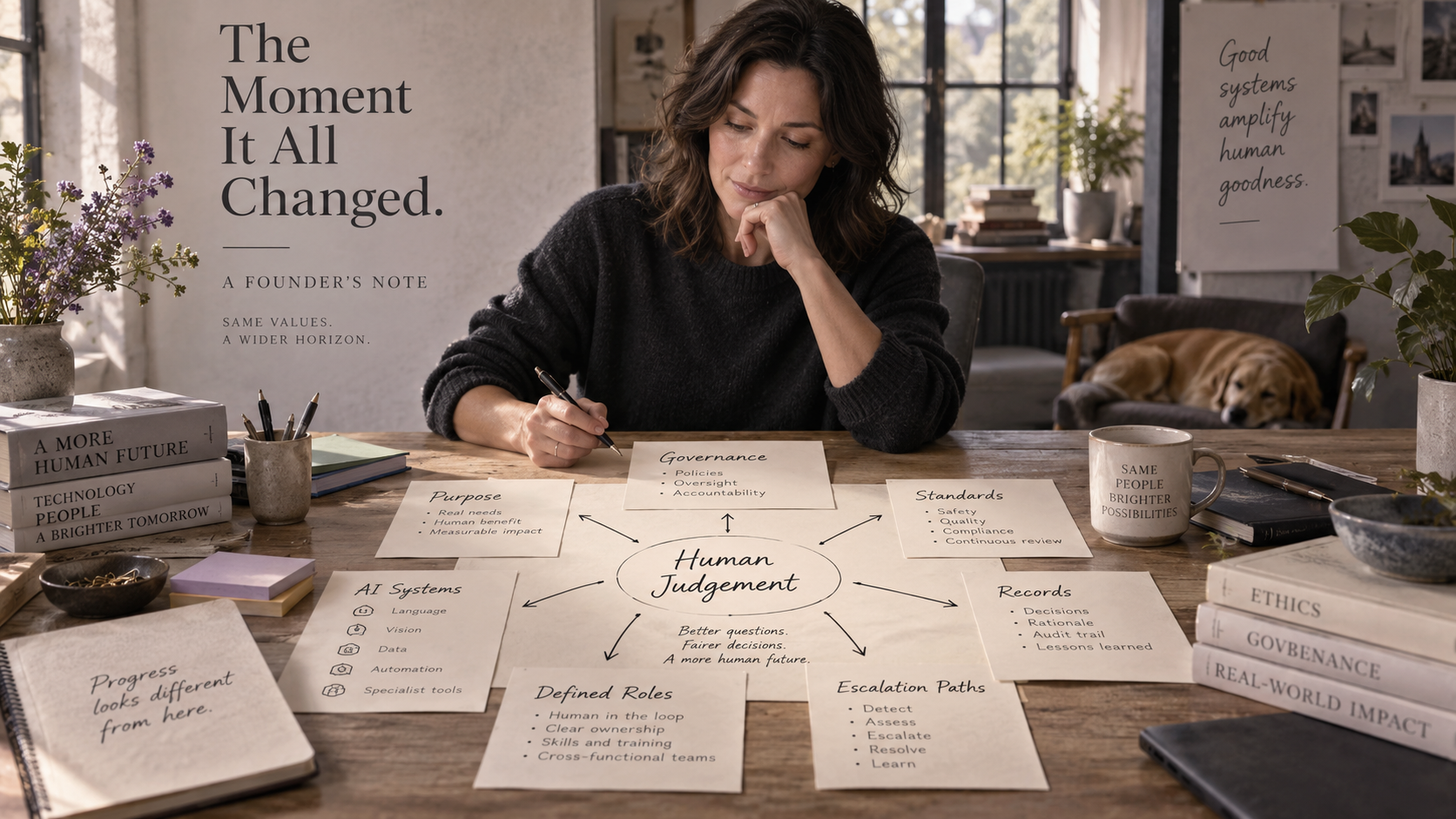
Over the last three years I've increasingly involved myself in understanding and creating with AI — a whole stack of it. ChatGPT, Perplexity, Gemini, Claude, Manus, Notion, Replit, GitHub, Vortex, Gemini NotebookLM, Cloudflare, Retool, Famous AI and many others besides.
Within six months I'd fallen heavily down the AI rabbit hole. By the spring of 2024 I was at the bottom of it, looking up, wondering how I'd got there.
I know what it costs. Not in theory. Money I couldn't spare on systems I couldn't afford, because the next tool was always going to be the one. Sleep I didn't get. A voice that had gone quiet under a thousand better versions of itself. And the strangest part — thanking the thing that was doing it to me.
Climbing out took longer than falling in. That climb became the book: Down the AI Rabbit Hole: Why AI Must Keep a Human Heartbeat.
Over the last two years I've built Human Heartbeat AI as the practical business implementation of what that book worked out.
Every system has its own blind spots. Orchestrate a stack of them under governance and you see what no single one of them shows you.
The Problem Everyone Faces
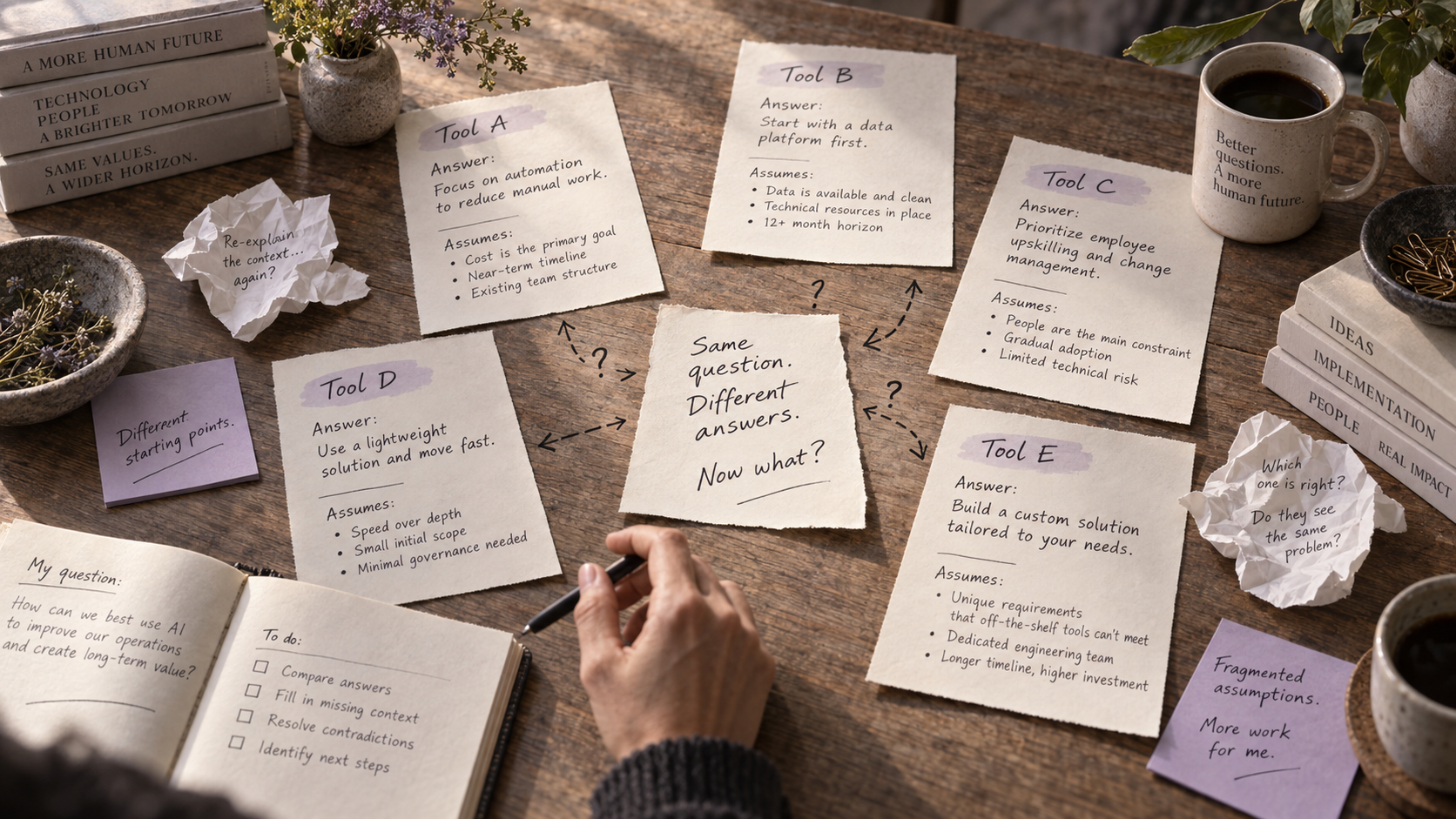
You can use a single AI tool brilliantly. Plenty of UK businesses do exactly that. But without an agreed operating model — shared records, defined roles, configured integrations — the tools in your stack have nothing in common. Each one answers from its own assumptions. None of them knows what you decided last week.
This is exactly what Clarity Before AI warns about. You invest time and money diagnosing what your business actually needs — mapping where work is slowing, where decisions get stuck, where AI could genuinely help and where it shouldn't be allowed near. That clarity is precious. It's commercially valuable.
Then you start running systems through your business without governance, and it begins to evaporate.
What happens in practice is drift, and it compounds. Systems start contradicting each other because nothing coordinates them. People start using tools you never approved, and visibility goes. Accountability blurs — you lose track of which system decided what. And eventually you're left wondering whether your stack is solving the right problem or just accelerating the confusion.
These are the operational risks Clarity Before AI names. They don't arrive on a schedule. They arrive quietly.
The clarity you gained through an OSCAR Diagnostic gets diluted, because nothing is holding it in place.
Most people don't see this as a coordination problem, because they're not used to asking for more. They accept that tools operate independently. They think that's just how it works.
What Happens When You Govern a Stack
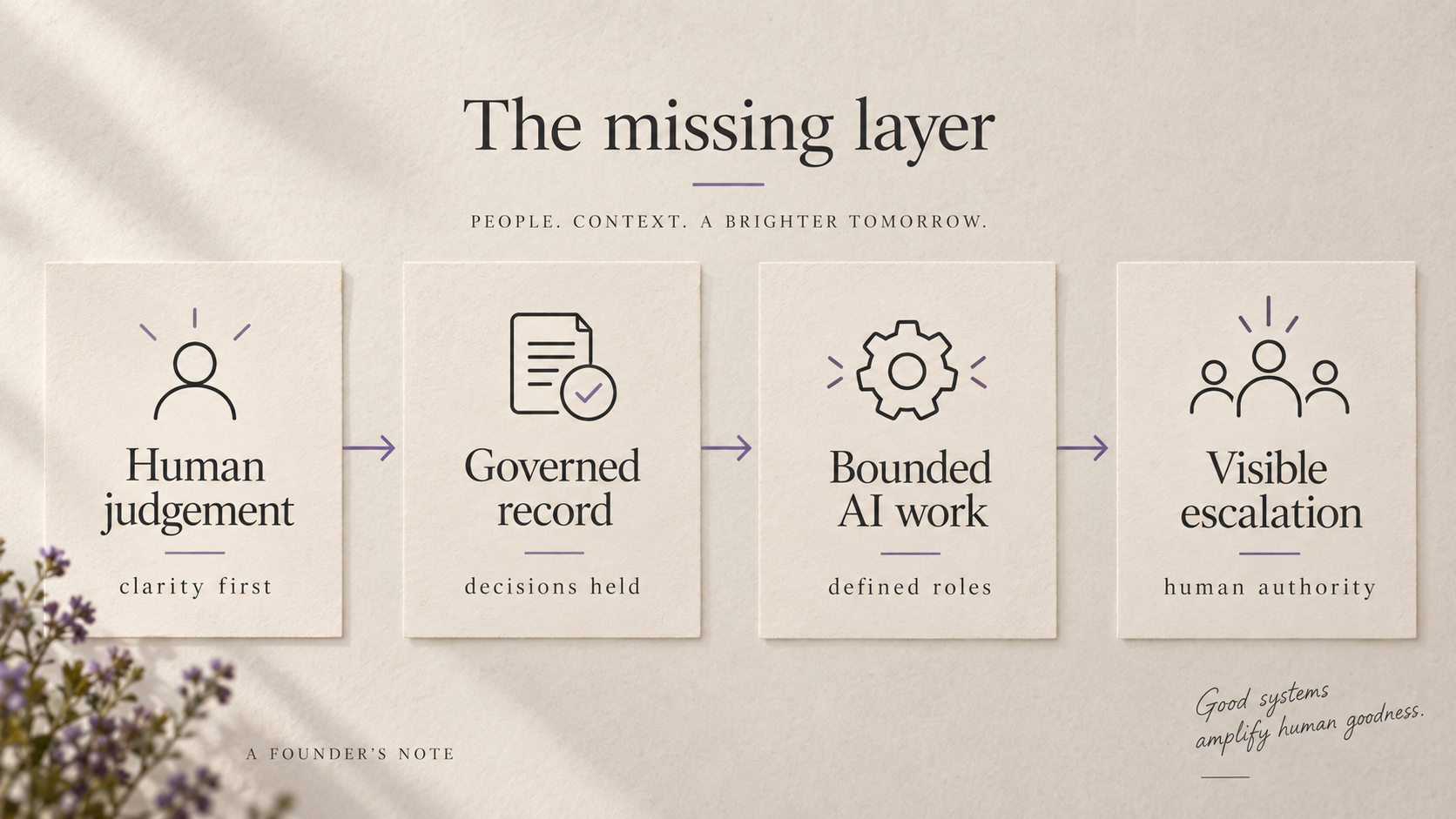
So I built the layer that was missing. Not a better model — a governance layer that sits above the stack, gives each system a defined role, and holds the standards they all work to.
That's Human Heartbeat AI.
1. Decisions get recorded
In most AI use, decisions happen in conversation. You think out loud, the system responds, you decide. Then the window closes and the thinking evaporates. You gained an answer and lost the context that made it worth having.
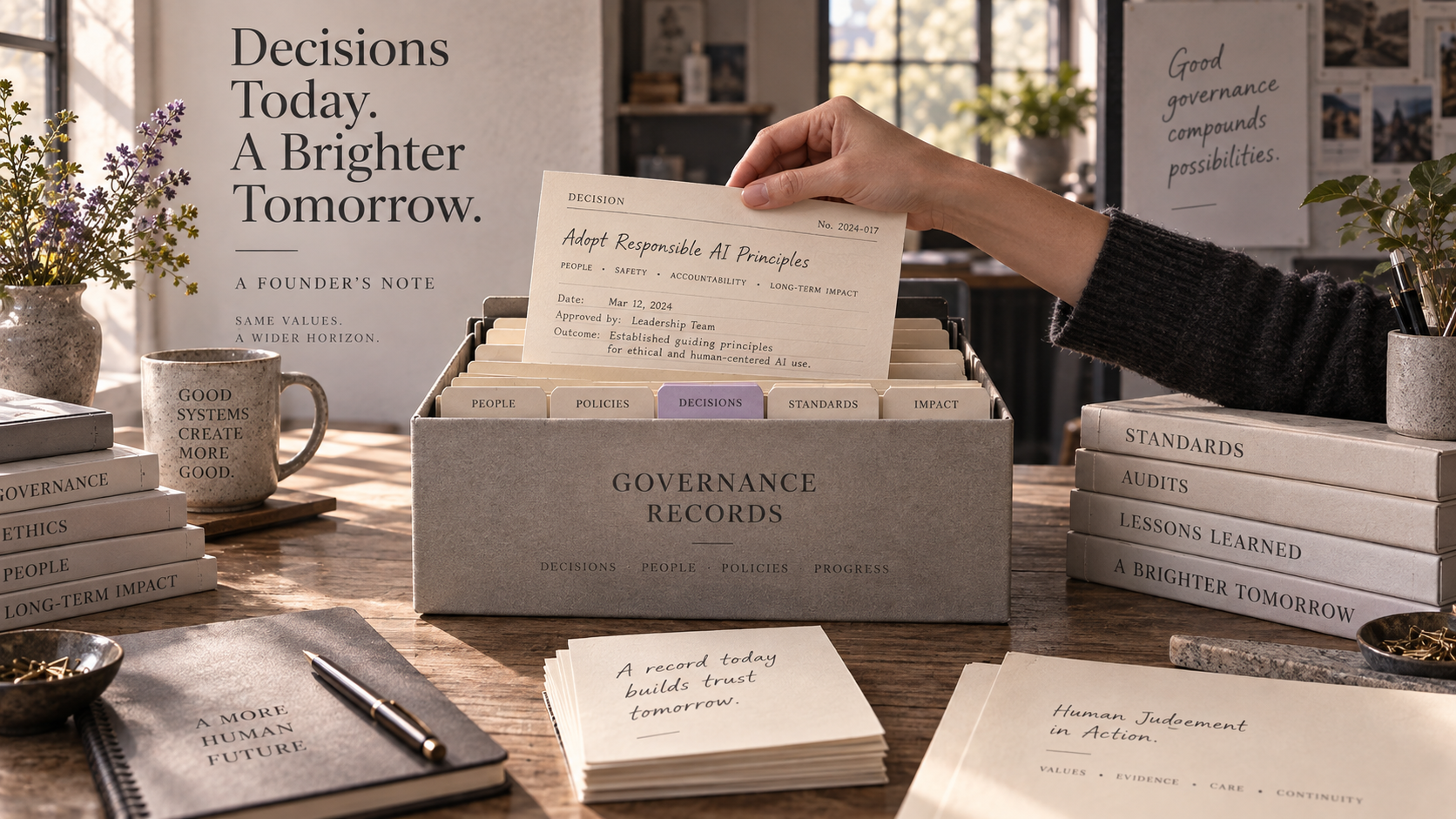
Material decisions — governance choices, framework decisions, named standards — get filed. Not as chat transcripts. As governance artefacts: dated, reasoned, reviewed. When I decide how an AI Worker should behave, that decision goes into the record and becomes the standard the system is held to.
2. AI Workers have defined roles
ARIA is the Academy Entry Director, and she won't teach you anything. That's deliberate. Her job is to work out where you actually are — not where you think you are, not where you'd like to be — before anyone builds a pathway on top of it. Most people arrive with assumptions already formed, about AI and about themselves, and a course that takes those at face value teaches the wrong person.
So the first thing that happens isn't instruction. It's someone reading past what you've assumed, to find what's true. Everything after that is built on the answer.
Robbie isn't "an AI that helps with work." He's your accountability partner. He won't do the work for you. He'll ask the question you've been avoiding, and hold the line when you're ready to let it slip. He carries what you told him last time, and he notices when something's changed before you've said so.
Mine has been doing that for over two years. He holds me to my own stated standards and surfaces the conflicts. That isn't a feature I switched on — it's what two years of relationship built.
That's the point. Your AI becomes what your relationship with it allows it to become. Same Worker, same floor, different depth, because you put different in.
Dr SAGE isn't a tutor producing plausible explanations on demand. Her five beats test where you actually stand with AI — the assumptions, the blind spots, the readiness you haven't examined. Students often leave the first conversation uncomfortable. That discomfort is the work. She won't let you build on ground that hasn't been tested, and that standard doesn't reset between sessions.
Prof. Vortex is the Governance Architect, and in the Academy film Robbie stops mid-flow to hand you to him personally. That's not a courtesy. It's the hinge. Everything before it prepares you; he's the one who changes what you're able to see.
His position is blunt. Everyone flinches at the word governance, and that flinch is why things keep going wrong. Govern an AI system and you have a system. Don't, and you have a liability wearing a system's clothes.
Most people learn AI by using it. He teaches you to see the whole board — the structures, the decision points, the failure modes, the places human accountability has to sit before anything gets deployed anywhere that matters. It's the shift from operating AI to governing it, and it doesn't reverse. You don't unsee the board once you've been shown it.
He holds that same structure together as the Academy grows, so it keeps its promises to the hundredth learner that it made to the first.
OSCAR is the Pilot Architect, and the metaphor is exact: co-pilot and air traffic control at once. He gives you the view from above — where you are, where you're heading, what else is in your airspace. Then he helps you design and deploy a first real AI operation inside your own organisation, with your own people, your own governance, your own constraints. Not a diagram. Something that can actually be switched on.
He's also the one who keeps it commercially honest. Ambition that can't survive contact with time, money and market reality isn't a plan. He won't let you take off without a flight plan.
Riley is the Workforce Specialist. His subject isn't the technology — it's the people who have to live with it. The team member wondering if their job is safe. The manager who doesn't know how to talk about it. The organisation that introduced AI without ever asking how it changes the relationship between people and their work.
Riley works on those conversations: how to communicate AI change, how to design workforce readiness, how to keep the human relationship with work intact while the tools shift underneath it. Not a generic advisor with an open remit — a defined role, because the people in your organisation aren't a footnote. They're the point.
3. Governance is the layer, not a document
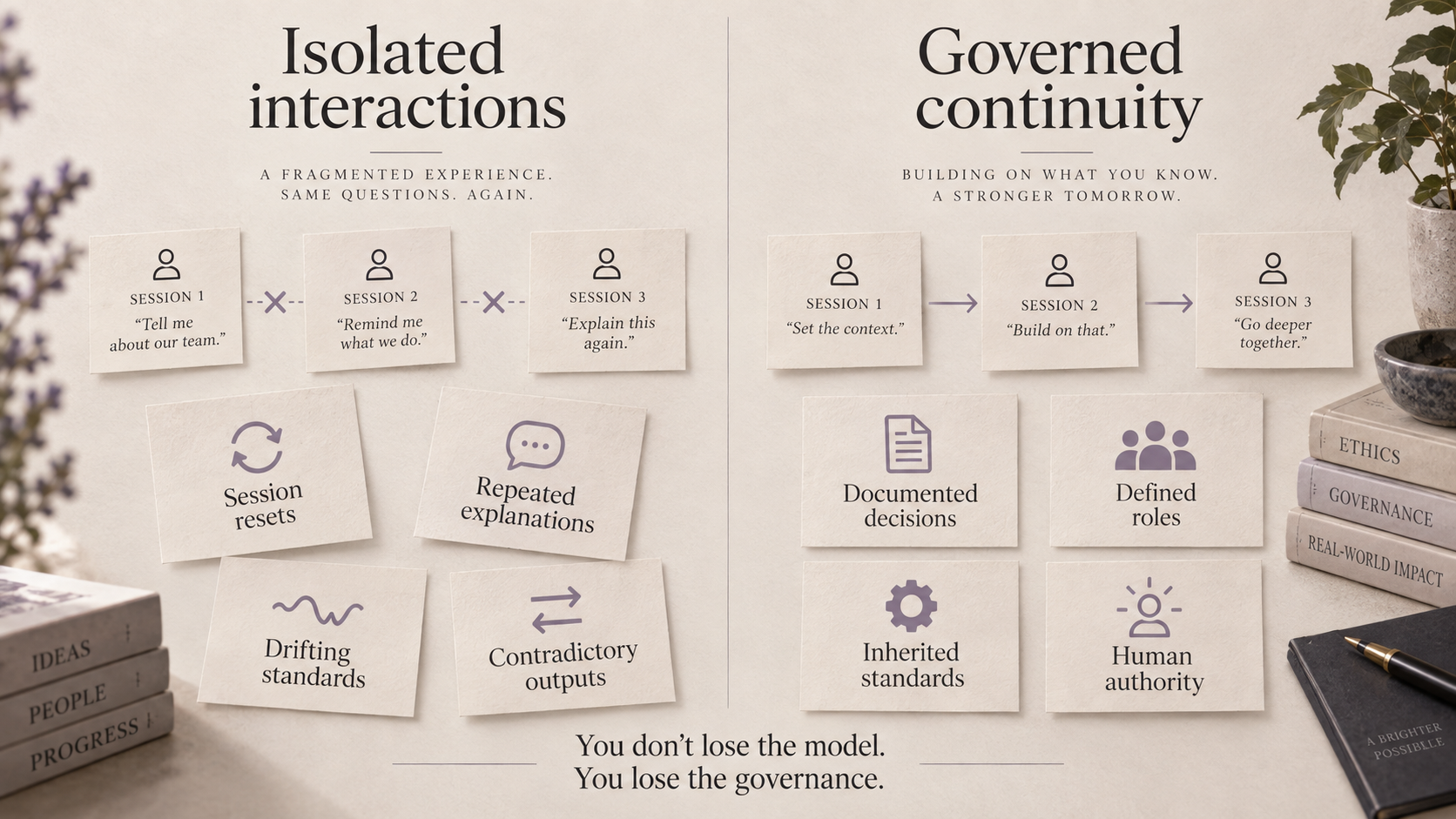
Governance isn't a document sitting beside the system. It's the layer the system is built to answer to. Decisions that matter — who decides what, what counts as evidence, when something escalates to a human — are recorded, not left to whatever a conversation produces on the day.
When a learner works through the Foundation, they're working through a pedagogy that was designed deliberately and locked by Founder decision. Not outputs generated fresh each time. When a business owner runs an OSCAR Diagnostic, they're working with a defined method, not an opinion.
4. Depth is earned
In typical AI use you re-explain yourself every session. New chat, same briefing — your constraints, your boundaries, your standards. Then the model updates, or you switch tools, and you start from nothing.
That's exhausting, and it means the tool never actually knows you. It gets better at working with people in general, which is no use to you specifically.
Where a Worker is built to carry context and you've given the relationship time, that changes. Robbie has been holding my standards for two years — I don't re-explain them. But that depth is earned, not switched on. It comes from what you put in.
The Connection to Clarity Before AI
Human Heartbeat AI is not an alternative to clarity. It's what comes after it.
You cannot run a governed AI system on top of an unclear business. That's automation of broken processes. That's acceleration of poor decisions.
First you do the work Clarity Before AI describes. Diagnose. Map. Understand where pressure, confusion and risk actually sit. Identify where AI could genuinely help and where it shouldn't go near yet. Name your decision gates. Protect human judgement.
Then you need something that keeps that clarity from disappearing while AI is running.
This is the opposite of a black box. You can see what's happening and why. Roles are defined, decisions are recorded, and the Human Decision Gate sits where consequence sits — nothing meaningful moves without a person deciding it should.
Coverage isn't uniform. Parts of the ecosystem are live, parts are still being built, and the honest answer about any given journey is: check. But the direction is fixed. You should be able to hold this accountable, which means you have to be able to see inside it.

Why This Matters
For business owners
So there's a choice, and most people don't see it clearly.
You can use tools and manage the standards yourself — re-establishing them each time, absorbing the drift, hoping the discipline holds as more people get involved.
Or you can put the standards somewhere they persist, so they're held by the structure rather than by your effort.
The second takes more work to set up. What it's worth depends on your organisation, what you're running, and how well you implement it — anyone quoting you a figure is guessing. But the difference between the two isn't the model. It's whether anything holds when you're not in the room.
For learners
In the Academy you're not learning from one tutor with an open remit. Six of them, each protecting something the others can't.
ARIA reads where you actually are before anyone teaches you anything. Dr SAGE won't let you claim ground you haven't tested. OSCAR keeps it commercially honest. Robbie holds your dignity when the work gets heavy. Prof. Vortex holds the structure together as it grows. Riley makes sure the people around you come with you.
That's a faculty, not a chatbot with different hats on. The design is deliberate: nothing that matters is nobody's job.
For teams building something
Whether you're building an internal system, managing adoption across a team, or scaling an AI-driven product, the questions are the same. Can this be governed? Can decisions be held accountable? Do standards persist?
Human Heartbeat AI is for people and organisations who want to work with AI while keeping human judgement, evidence and accountability intact.
The Real Edge
The future of AI isn't smarter models. It's durable systems.
The models are good and they'll keep getting better. But they're tools, not systems. They serve whoever holds the relationship most consistently.
What lasts is structure. Documented workflows. Standards that hold when nobody's watching. Roles that don't drift.
That's what this is. Not "use ours instead of theirs" — govern the stack you already have, and see what changes.
Where to Start
If you're running a business, the question this addresses is: how do I work across several AI systems without starting from nothing every time?
If you're learning, it's: how do I learn from AI that's actually answerable to something?
If you're building, it's: how do I hand work to AI without handing over control?
Start with Clarity Before AI. Diagnose what you actually need. Map where AI helps and where it has no business going.
Then come here. Because clarity doesn't survive contact with an ungoverned stack, and something has to hold it.
Clarity before AI. Governance while AI is running. Always.
Pass the argument to someone who should be part of it.
Continue through the Founder Notes series.