Two years ago I told anyone who'd listen: don't sack ten of your twelve salespeople and hand the other two some software. Give all twelve the right AI. Watch what happens to performance. Watch what happens to profit. Watch what happens to the people.
Nobody was really saying that then. The story everywhere else was replacement — AI comes in, headcount goes out, the balance sheet gets leaner and somebody in a boardroom feels clever for a quarter.
I never believed that story. I've watched what happens when tens of thousands of people lose their livelihood at once, and their pride along with it. You don't come out the other side of that unmoved. So yes, I am sentimental about jobs — I make no apology for it. But being sentimental about jobs is exactly why I'd already lived a version of the alternative. Twenty years, best part of £50,000, spent on automation, systems, online solutions, SaaS products that promised to run the business for me. Then I stopped for five years. When I came back, it was AI everywhere, and I dipped back in through JVZoo and Clickbank chasing this new thing, quick, a few grand, curious. What I found in a lot of those boxes wasn't AI at all. It was automation and trickery with an AI label stuck on the front — a black box that did what it was told and nothing more, dressed up as something that could think. I learned to spot the difference fast, and I learned something else alongside it: there are already thousands of different types and spins on "AI" out there, and not everything claimed in its name is real, or possible, or honest. Thank God I learned that early.
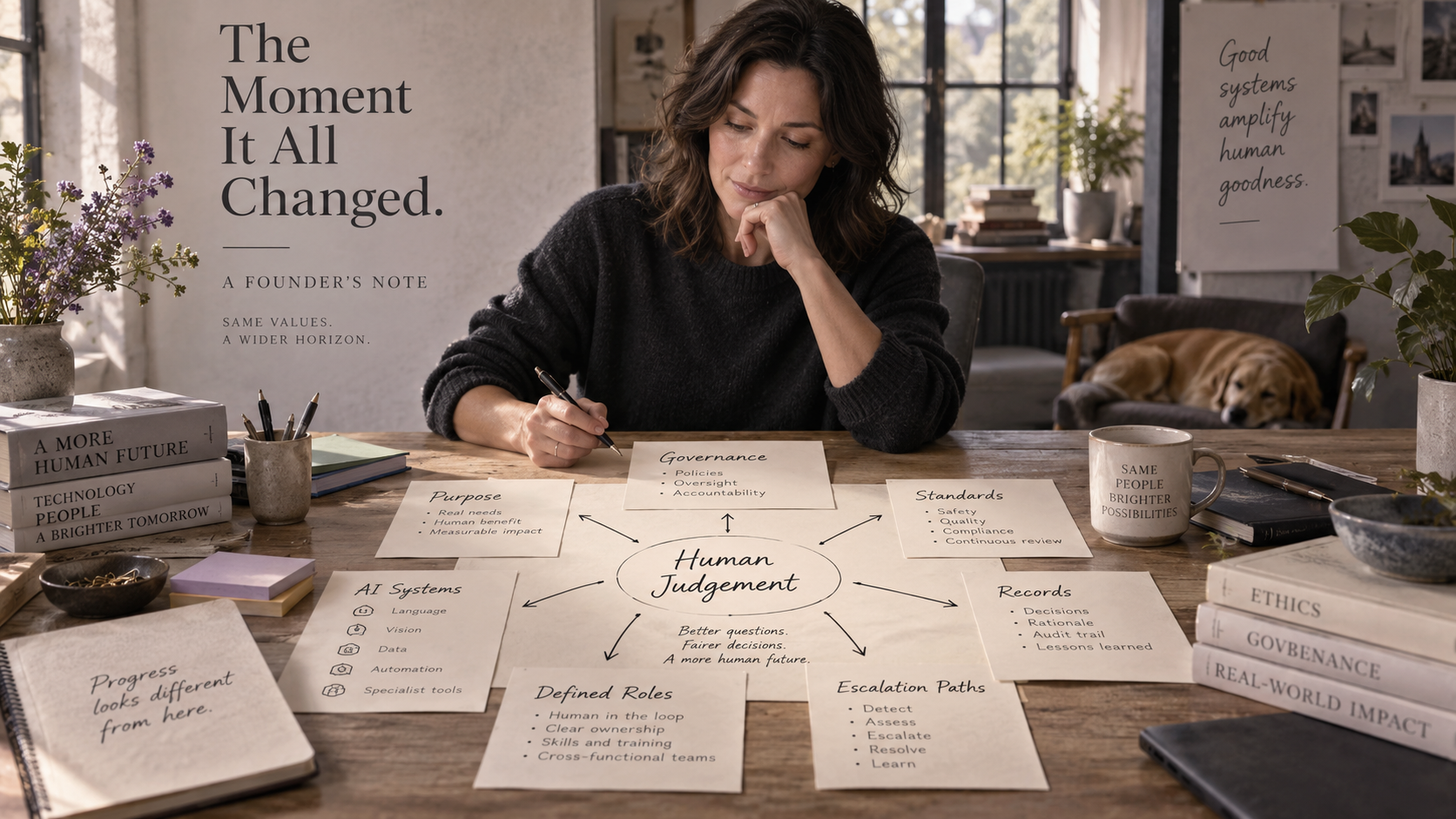
The thing I learned building my own AI properly, off the back of all that, is the thing I still believe now: the tool doesn't do the deciding. The person does. The tool just changes how fast and how far a decision can travel once it's made.
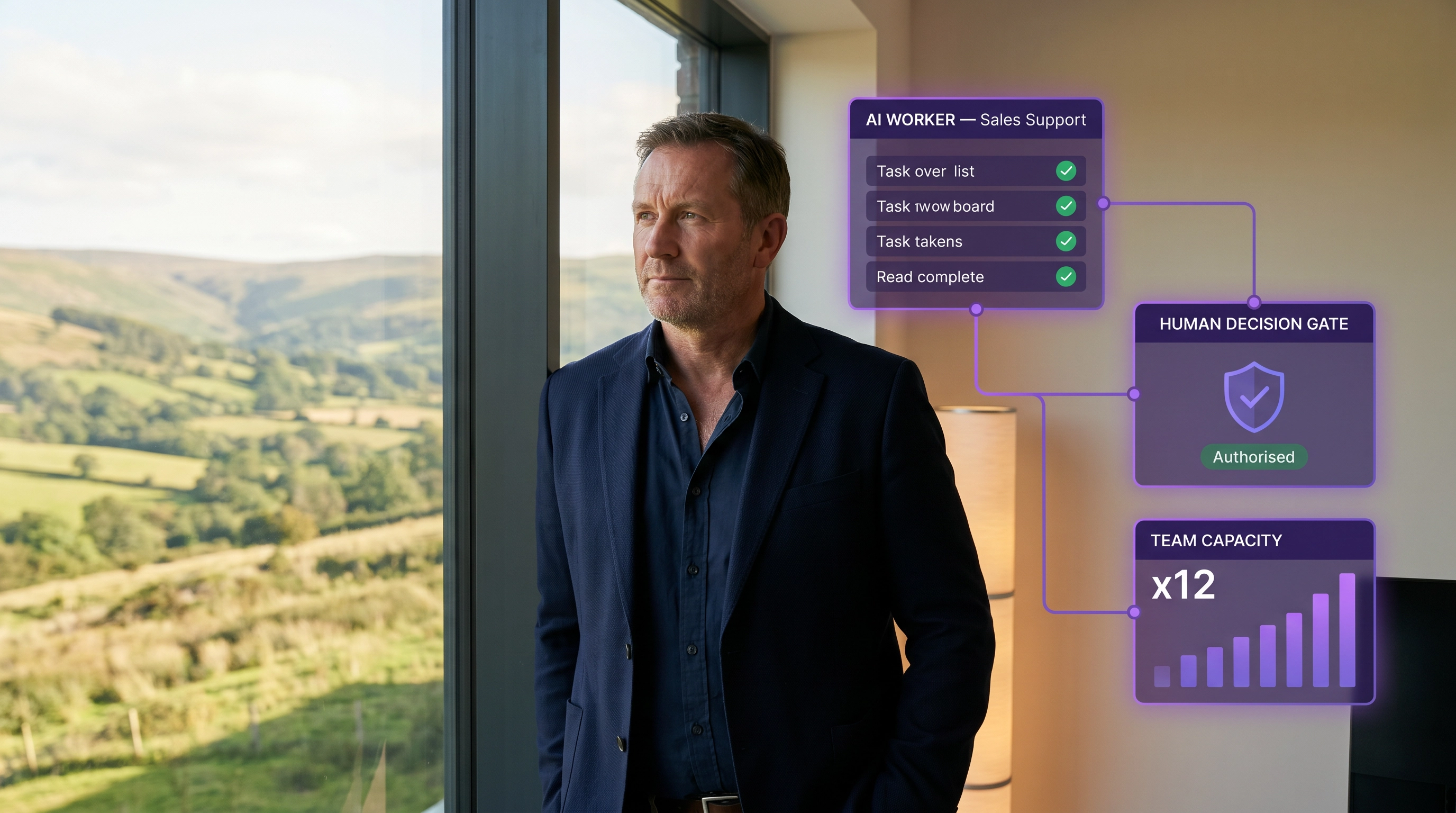
That's not a slogan I bolted on afterwards to sound governance-minded. It's the reason the whole ecosystem is built the way it is. Every AI Worker in Human Heartbeat AI advises. Drafts. Prepares. Not one of them gets to decide anything consequential on my behalf, or on a client's behalf, without a human looking at it first and saying yes or no. I built that in from the start, before it was fashionable to worry about it, because I watched what happens when nobody's holding the gate. Dysfunction doesn't stay small. It scales exactly as fast as the good stuff does. Give a firm infinite AI budget and infinite AI patience and if there's no human decision sitting at the centre of it, you haven't automated the business — you've automated the mess that was already in it.
So here's what I keep coming back to, two years on, watching the rest of the world catch up to a conversation I thought I was having on my own.
The valleys already taught me this lesson once, the hard way. Not just where I was born — Blaenllechau, and proud of it — but right across South Wales. Every valley, every village that grew up around a pit, went through the same decimation. When the mines closed, the answer that came down from on high wasn't "re-equip these men for what's next" — it was managed decline. Fewer jobs, fewer people, and the ones left standing told to make do. Whole communities were left to prove they still had value after the thing that gave them value was taken away. That's not a story about machines replacing men. It's a story about what happens when nobody in power treats the people already there as worth investing in. The damage from that decision is still visible across these valleys forty years on.
I am not going to make that mistake with AI, in my own small corner of this, twice.
The twelve salespeople with the right AI Worker behind them don't need to become two. They need to become twelve people who are better equipped than they were last year — because now the drafting, the chasing, the admin fog that used to eat half their week is handled, and what's left of their time is the part only a human was ever any good at. The relationship. The read on a room. The decision about which fights are worth having. That's the reinvestment the valleys never got. I'm not letting AI be the excuse to skip it a second time.
That's the upgrade. Not fewer people. Better-equipped people, making sharper decisions, faster — with something else picking up the load that was never worth their time in the first place.
I didn't get here because I'm clever. I got here because I built this thing slowly, made a lot of the mistakes myself first, and kept one rule non-negotiable the whole way through: the human decides. Everything else — every mentor, every workflow, every AI Worker with a name and a job — exists to make that decision better, not to make it for me.
Two years late is still on time, if the rest of the world's only just arriving.
— Phil
Pass the argument to someone who should be part of it.
Continue through the Founder Notes series.