
A business leader at his desk reviewing AI management output, with floating purple UI panels showing Human Decision Gate, Instruction Clarity, and Accountability — the three pillars of governed AI deployment.
The technology was never the hard part. Deciding, deliberately and every time, who is accountable for what it produces — that is the part worth getting right.
AI Adoption

AI Didn't Cut Your Headcount. It Removed Your Excuse Not to Manage Properly.

The promise was fewer staff, lower costs, the same output. That wasn't what happened. What AI actually did was remove every excuse for not managing well — and compound whatever was already happening in the business, good and bad, at a speed no human team could match.

Phillip LlewellynFounder, Human Heartbeat AI6 min read
AI AdoptionHuman Decision GateGoverned AIAI Workers

For a long time, the pitch for AI in business was simple: it would do the work so people didn't have to. Fewer staff, lower costs, the same output. That was the promise sold to boardrooms across every sector, and for a while it was compelling enough that nobody stopped to check whether it was true.

It wasn't. Not in the way it was sold.

What AI actually did was cheaper than most businesses expected — and far harder to control than anyone admitted. Every organisation that has adopted AI Workers at any scale has run into the same discovery: capability without governance doesn't save money, it multiplies whatever was already happening in the business, good and bad, at a speed no human team could match on their own.

The New Scaling Problem

A business that mismanages twelve employees has a containable problem. A business that mismanages twelve AI Workers, each capable of running continuously, generating output around the clock, has an uncontainable one. Dysfunction that used to take months to compound now compounds in days.

This isn't a criticism of AI. It's a description of what happens when any high-leverage capability is deployed without a clear structure for who decides what, and when. Organisations have faced this exact problem before — most notably in the early railway era, when a sudden leap in operational capability outran the management structures needed to keep it safe. The lesson from that period wasn't to slow the technology down. It was to build the layer of human decision-making the technology had outpaced. Modern management, in large part, exists because of that lesson.

AI is forcing the same reckoning, on a shorter timeline.
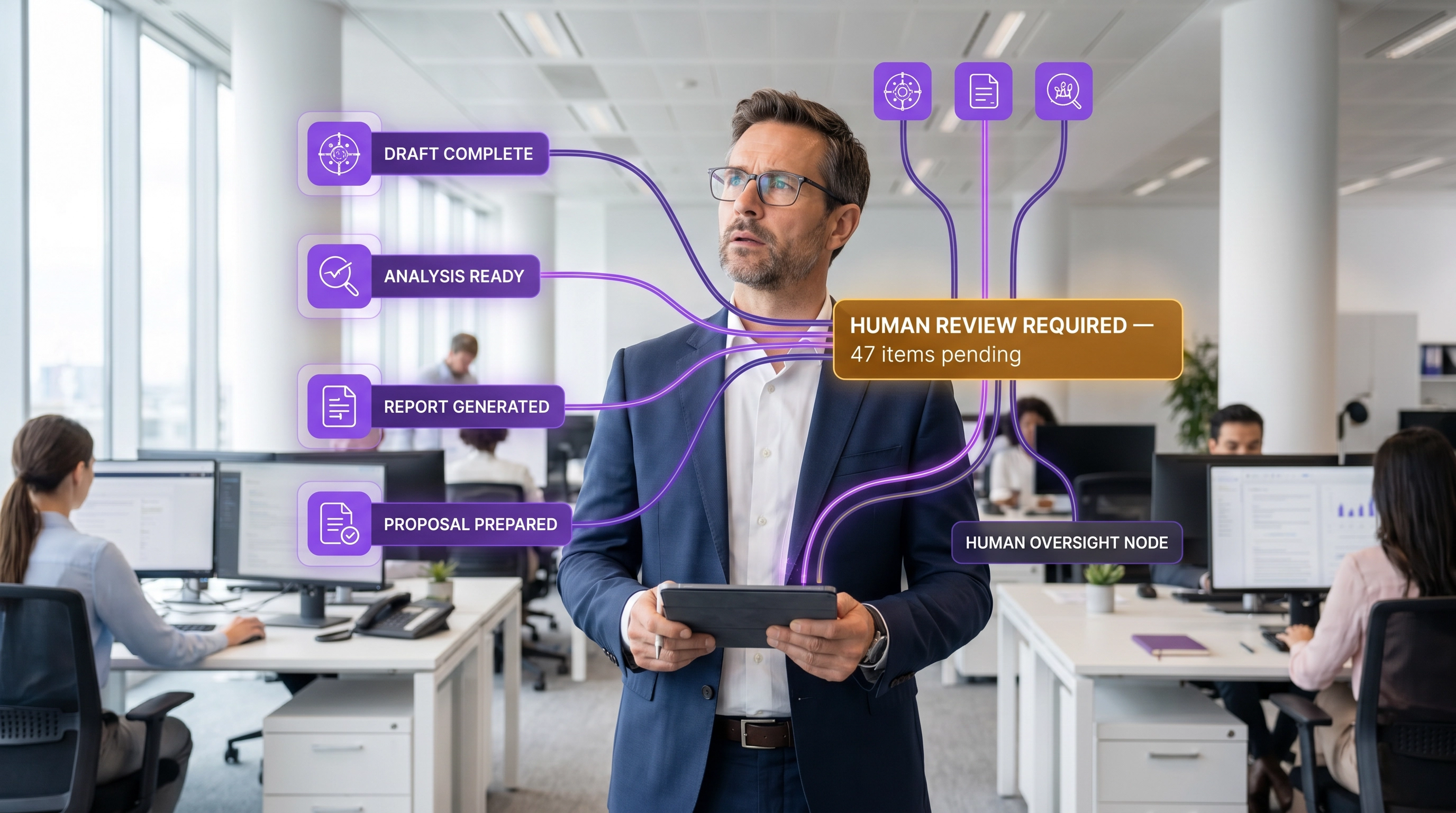
A manager in a modern open-plan office surrounded by floating purple AI output streams — Draft Complete, Analysis Ready, Report Generated, Proposal Prepared — all converging on a central Human Review Required node. The visual shows AI operating at scale, with human oversight as the critical bottleneck.
The New Scaling Problem: AI Workers don't slow down. The question is whether the human management layer is built to match the speed at which they produce output.

Advising Is Not Deciding

At Human Heartbeat AI, we work from one governing principle across every engagement: AI Workers advise, prepare, and draft. They do not decide. Every consequential action — financial, reputational, operational — passes through a Human Decision Gate before it becomes real.

This is not caution for its own sake. It's the only structure we've found that lets a business capture AI's genuine leverage — speed, consistency, tireless first-drafts — without inheriting its genuine risk: confident, well-formatted output that is quietly wrong, unaccountable, or moving faster than anyone intended.

The businesses getting real value from AI right now are not the ones that deployed the most of it. They're the ones that built the clearest structure for deciding when to trust it.

AI Workers advise, prepare, and draft.

They do not decide.

Every consequential action passes through a Human Decision Gate before it becomes real.
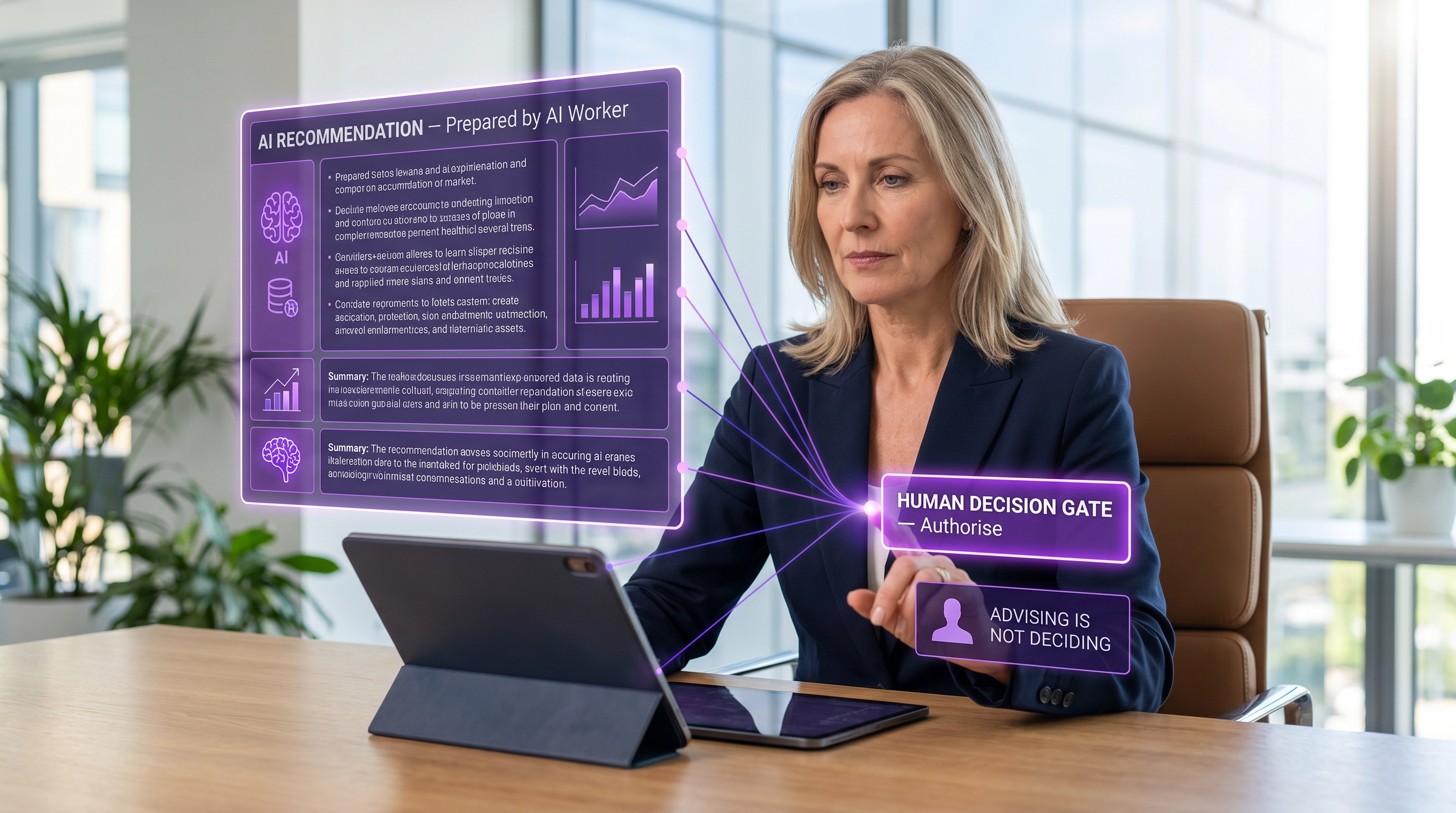
A senior professional woman reviewing an AI recommendation document on a tablet, with a floating Human Decision Gate authorisation panel beside her. The visual illustrates the moment of human authority — AI advises, the human decides.
Advising Is Not Deciding: Every consequential action passes through a Human Decision Gate before it becomes real. That is not caution — it is the only structure that makes AI's speed usable rather than dangerous.

What Actually Needs Managing

Three things determine whether an AI deployment strengthens a business or quietly destabilises it.
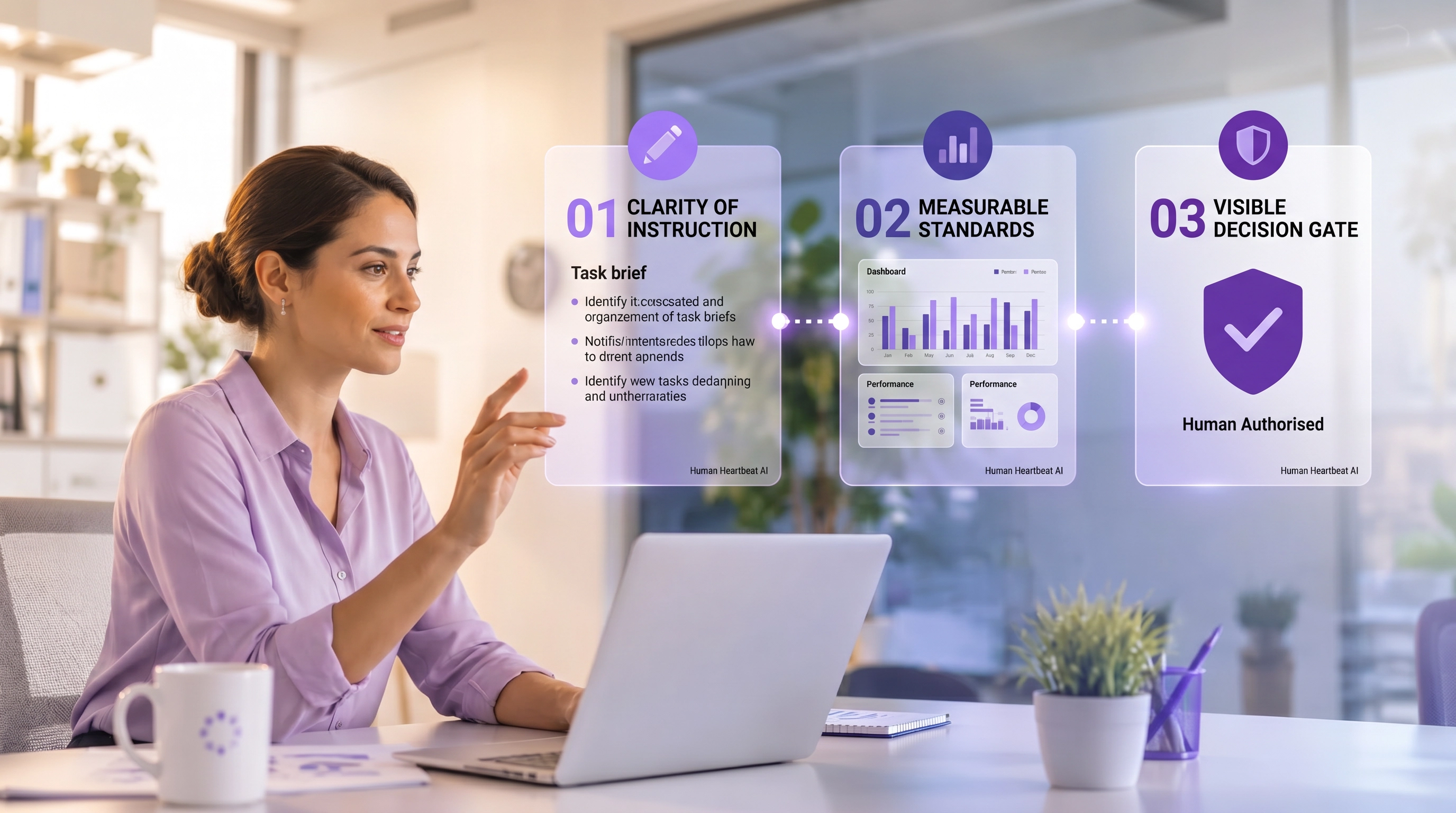
Branded infographic showing the three management pillars for AI deployment: 01 Clarity of Instruction, 02 Measurable Standards, 03 A Visible Decision Gate. Human Heartbeat AI branding. Dark navy and indigo colour scheme.
Three Things That Determine Whether AI Strengthens or Destabilises a Business: Get these three right, and AI compounds a business's existing strengths. Get them wrong, and it compounds the business's existing weaknesses at the same speed. Original graphic, Human Heartbeat AI.

The Opportunity Underneath the Risk

None of this is an argument for caution over adoption. It's an argument for adoption that actually holds up.

The businesses we work with are not being told to choose between growth and control. They're being shown how to build growth on top of control — governance not as a brake on AI, but as the structure that makes its speed usable rather than dangerous. A well-governed AI deployment doesn't just avoid the failure mode. It outperforms an ungoverned one, because trust — in the output, in the process, in the people responsible for it — is what allows a business to actually rely on what AI produces, rather than re-checking everything by hand.

That trust has to be built deliberately. It doesn't arrive with the software.

Where This Leaves SMEs

Enterprise businesses are already having this conversation, often expensively and often after something has gone wrong. SMEs have an advantage most haven't recognised yet: they're small enough to build the governance layer properly from day one, rather than retrofitting it onto years of ungoverned deployment.

That's the work. Not implementing AI faster than the business next door. Building the decision-making structure that lets AI be trusted, checked, and genuinely useful — for as long as the business exists, not just for the first six exciting months.

The technology was never the hard part. Deciding, deliberately and every time, who's accountable for what it produces — that's the part worth getting right.

Questions answered in this article

Did AI actually reduce headcount in most businesses?
Not in the way it was sold. AI reduced the cost of certain tasks but did not eliminate the need for human management. What it did was amplify whatever management structure was already in place — good or bad — at a speed no human team could match.
What is the Human Decision Gate?
A Human Decision Gate is the principle that AI Workers may advise, prepare, and draft, but a named human must authorise before any AI-assisted output becomes a real-world action. It is not a policy document — it is a working gate, applied every time.
What three things determine whether AI strengthens or destabilises a business?
Clarity of instruction (tasks clearly defined before the AI touches them), measurable standards (a checkable definition of correct, domain by domain), and a visible decision gate (a named, accountable human who holds authority to say yes or no before AI output becomes a real-world action).
Why do SMEs have an advantage in AI governance?
SMEs are small enough to build the governance layer properly from day one, rather than retrofitting it onto years of ungoverned deployment. Enterprise businesses are often having this conversation after something has already gone wrong.

Share this article

← Back to Articles

Choose your next useful place

Take the idea somewhere useful.

Continue through established public resources. These links do not add you to a list or start an automated journey.

Read Founder NotesHear the Founder’s perspective in full.
Go there
See today’s AI evidenceExplore the approved Breaking Stories archive.
Go there
Explore the ecosystemReturn to the wider map of routes.
Go there