
The Missing Layer In Most AI Adoption
Many organisations approach AI as if the problem is tool selection. They test platforms. They experiment with prompts. They automate isolated tasks. They encourage staff to try AI. They look for quick efficiency gains.
Some of that activity can be useful. But without a governed operating model, it also creates risk.
AI can produce content without context. AI can create recommendations without accountability. AI can accelerate poor processes. AI can expose sensitive data. AI can blur the line between support and decision-making. AI can make a business feel more advanced while quietly becoming less controlled.
The real issue is not whether AI can do something. The issue is whether AI should do it, under what conditions, using which source of truth, with what human review, and with what evidence trail.
That is the missing layer.
AI Should Handle Volume. Humans Should Retain Judgement.
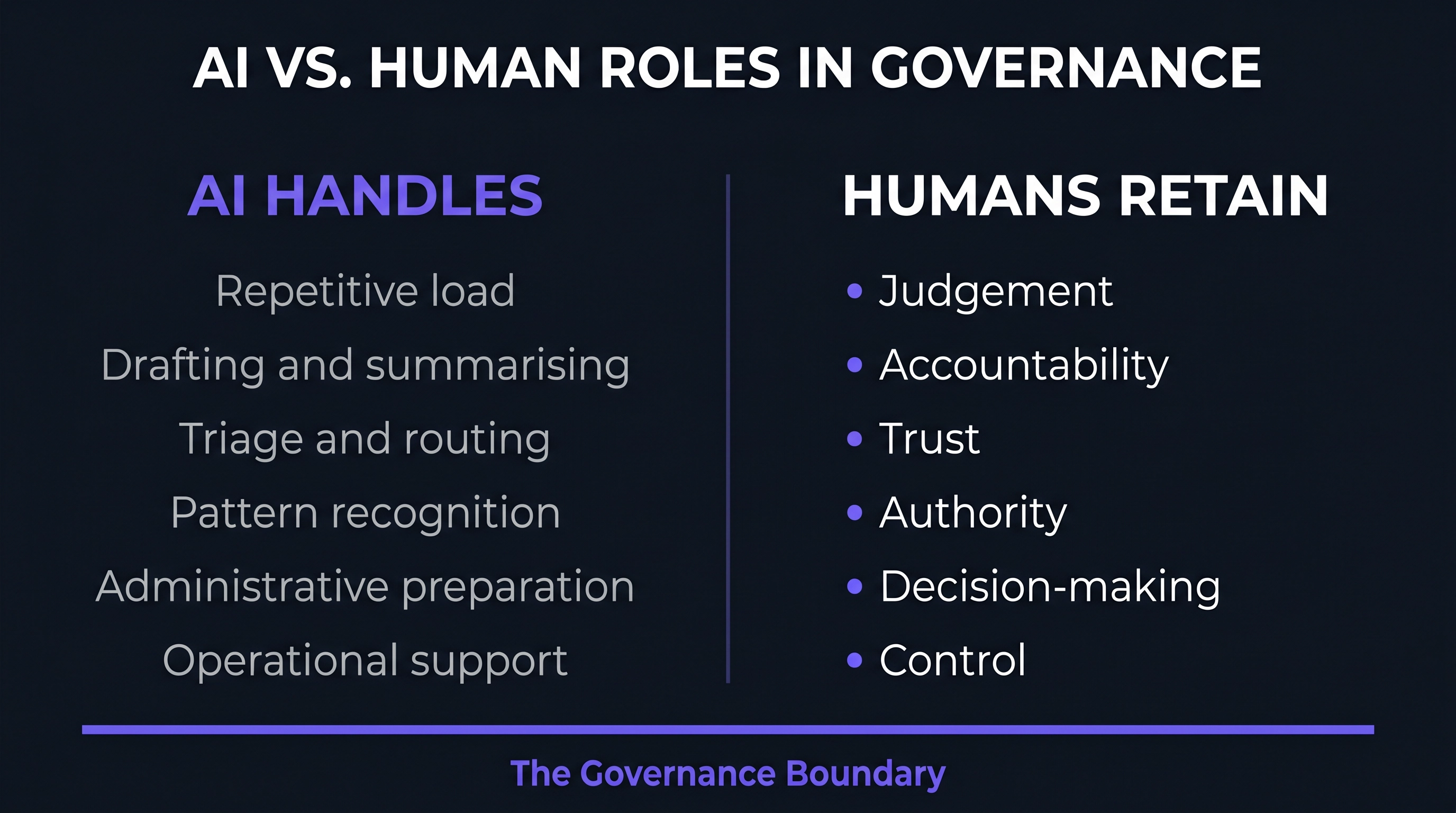
One of the clearest ways to understand responsible AI adoption is this: AI can handle volume. Humans must retain judgement.
This is the distinction that many businesses need before they introduce AI Workers into their operations.
AI can help with repetitive load, drafting, summarising, triage, pattern recognition, administrative preparation, and operational support. It can reduce friction. It can improve speed. It can create capacity.
But it should not silently become the authority.
A governed AI Worker is not just a chatbot, a prompt, or a workflow. It is a bounded business role operating inside a controlled system. It needs defined permissions, source-of-truth rules, escalation points, review requirements, and clear limits on what it may and may not do.
That is the difference between automation and governed adoption.
Why Integration Matters
The businesses that benefit most from AI will not simply be the ones that buy the newest tools. They will be the ones that integrate AI into the business properly.
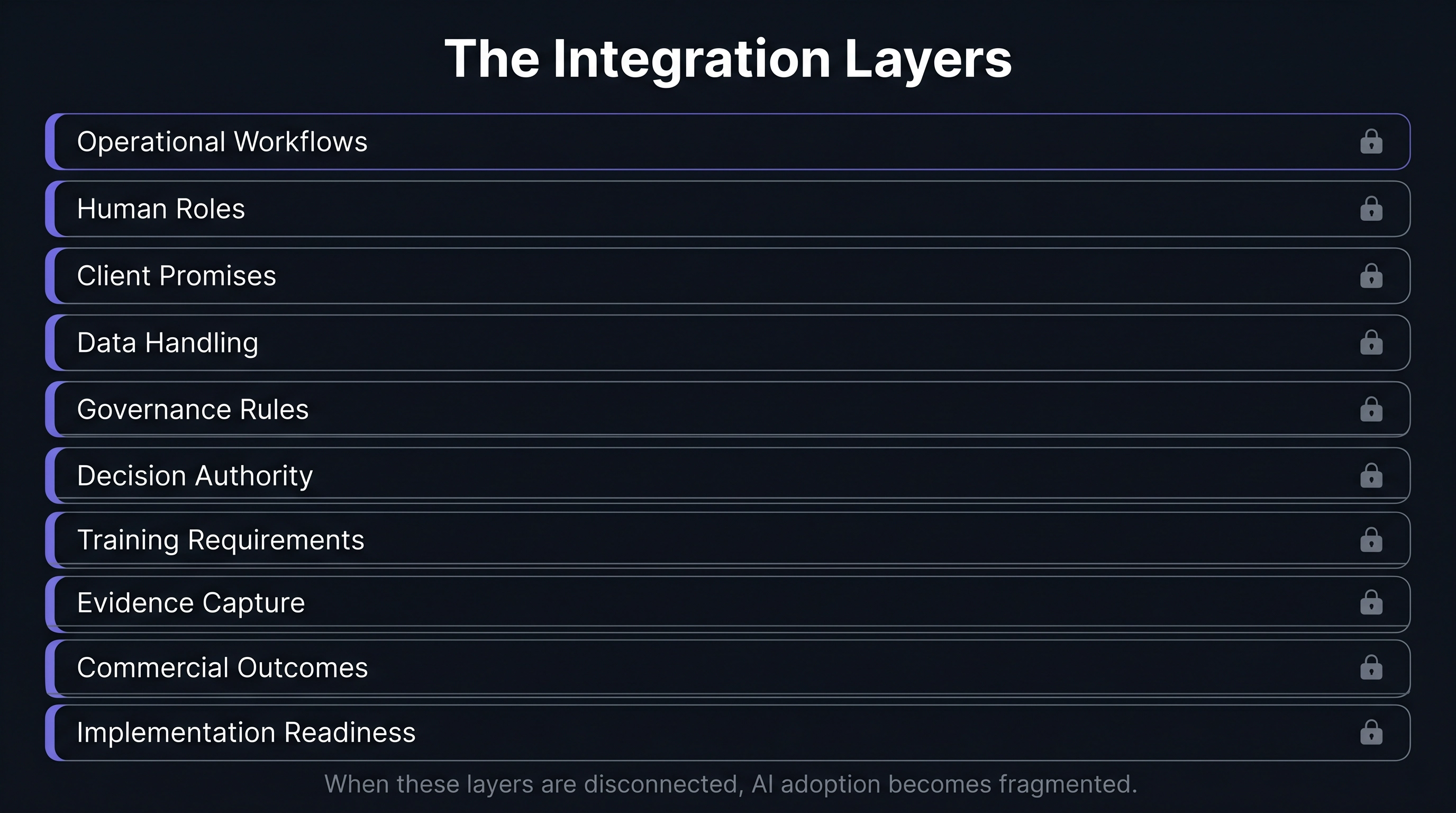
That means connecting several layers that are often treated separately: operational workflows, human roles, client promises, data handling, governance rules, decision authority, training requirements, evidence capture, commercial outcomes, and implementation readiness.
When these layers are not connected, AI adoption becomes fragmented. A business may have impressive tools but unclear accountability. It may have enthusiastic staff but no usage boundaries. It may have automation opportunities but no reliable process map. It may have client-facing AI ideas but no governance discipline.
That is why Human Heartbeat AI uses the OSCAR Diagnostic as the required starting point before implementation. OSCAR exists to see the whole system before anything is built.
Why OSCAR Comes First
OSCAR is not a generic AI readiness quiz. It is a diagnostic designed to understand where a business currently stands, where AI may help, where AI should not yet be used, and what needs to be in place before implementation becomes responsible.
It looks beyond tool appetite. It considers operational maturity, governance readiness, decision boundaries, risk exposure, implementation constraints, and the human accountability structure around AI use.
That matters because the wrong AI implementation can create false confidence. It can give a business the appearance of progress while embedding unclear responsibility, weak evidence, or unsafe decision delegation.
OSCAR is designed to prevent that. The aim is not to slow progress down for the sake of caution. The aim is to make progress safer, clearer, and more commercially useful.
A business that understands its AI adoption posture can make better decisions. It can prioritise the right use cases. It can avoid premature automation. It can protect human judgement. It can move into implementation with a stronger operating foundation.
Not which AI tool should we use.
What should AI be allowed to do here.
What must remain human.
How will we know the difference.
From Experimentation To Operating Discipline
AI adoption is moving beyond experimentation. For SMEs, the next phase will not be defined by who has tried the most tools. It will be defined by who can use AI consistently, safely, and productively inside the operating rhythm of the business.
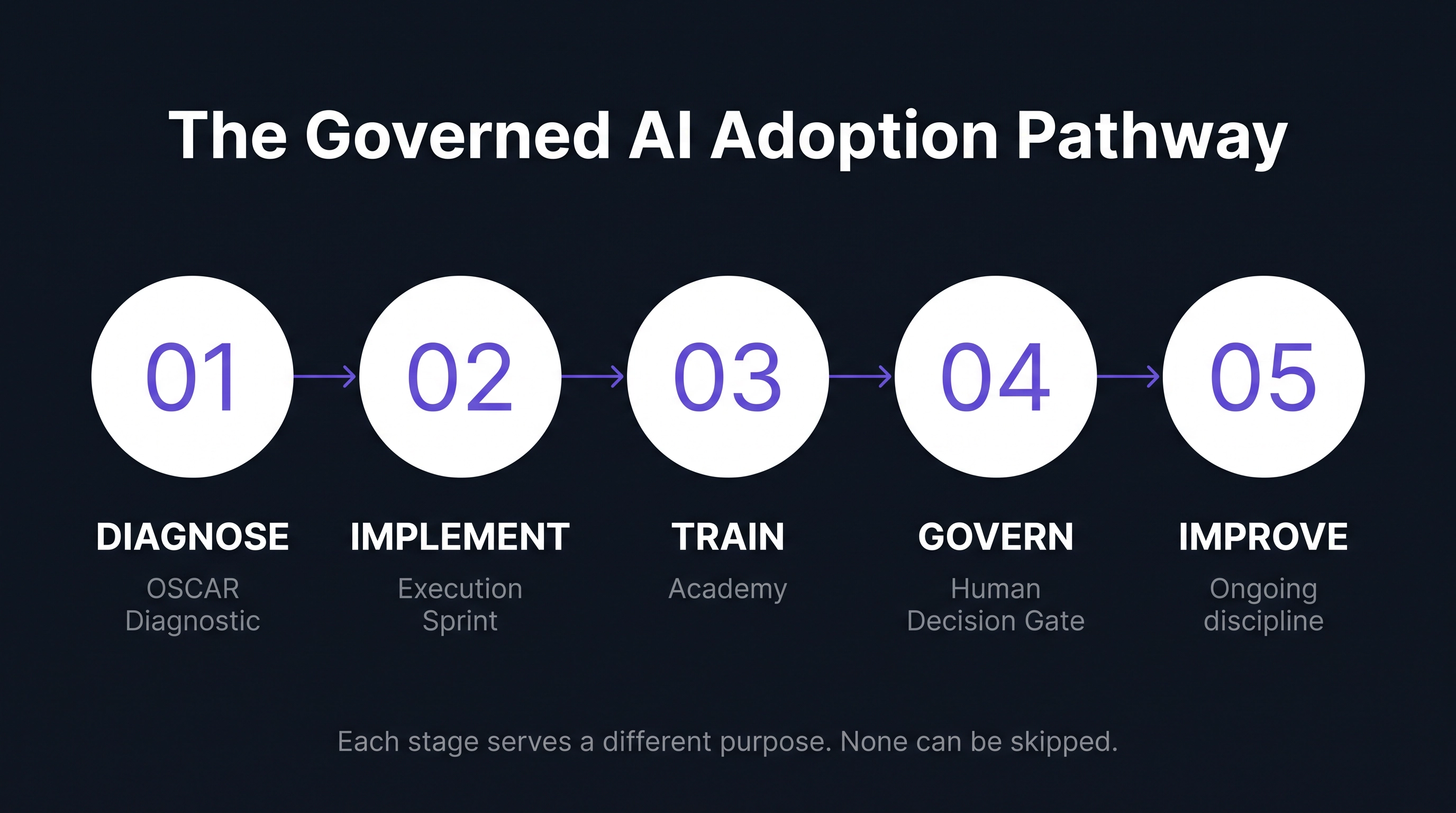
That requires more than curiosity. It requires a governed pathway: Diagnose. Implement. Train. Govern. Improve.
The OSCAR Diagnostic identifies the adoption posture and recommended next step. The Execution Sprint supports practical implementation. The Human Heartbeat AI Academy builds the training, confidence, and operating discipline required for AI-supported work to scale safely.
Each stage serves a different purpose. Diagnosis clarifies the system. Implementation builds carefully. Training embeds adoption. Governance protects judgement. Improvement keeps the business moving forward without losing control.
The Human Heartbeat Principle
AI should be a decision-support intelligence layer. It should not become an invisible decision-maker.
This principle sits at the centre of Human Heartbeat AI. The future of AI adoption is not human versus machine. It is not automation at all costs. It is not endless experimentation without structure.
The future is governed collaboration. AI can increase business capacity. Humans must retain accountability. Systems must make that relationship clear.
That is why AI adoption must be treated as an integrative business-governance problem, not a tool problem.
The companies that understand this will be better placed to adopt AI with confidence, protect trust, and build operating systems that are fit for the next phase of work.
Before a business asks which AI tool it should use, it should ask: what should AI be allowed to do here, what must remain human, and how will we know the difference?
That is where responsible AI adoption begins.