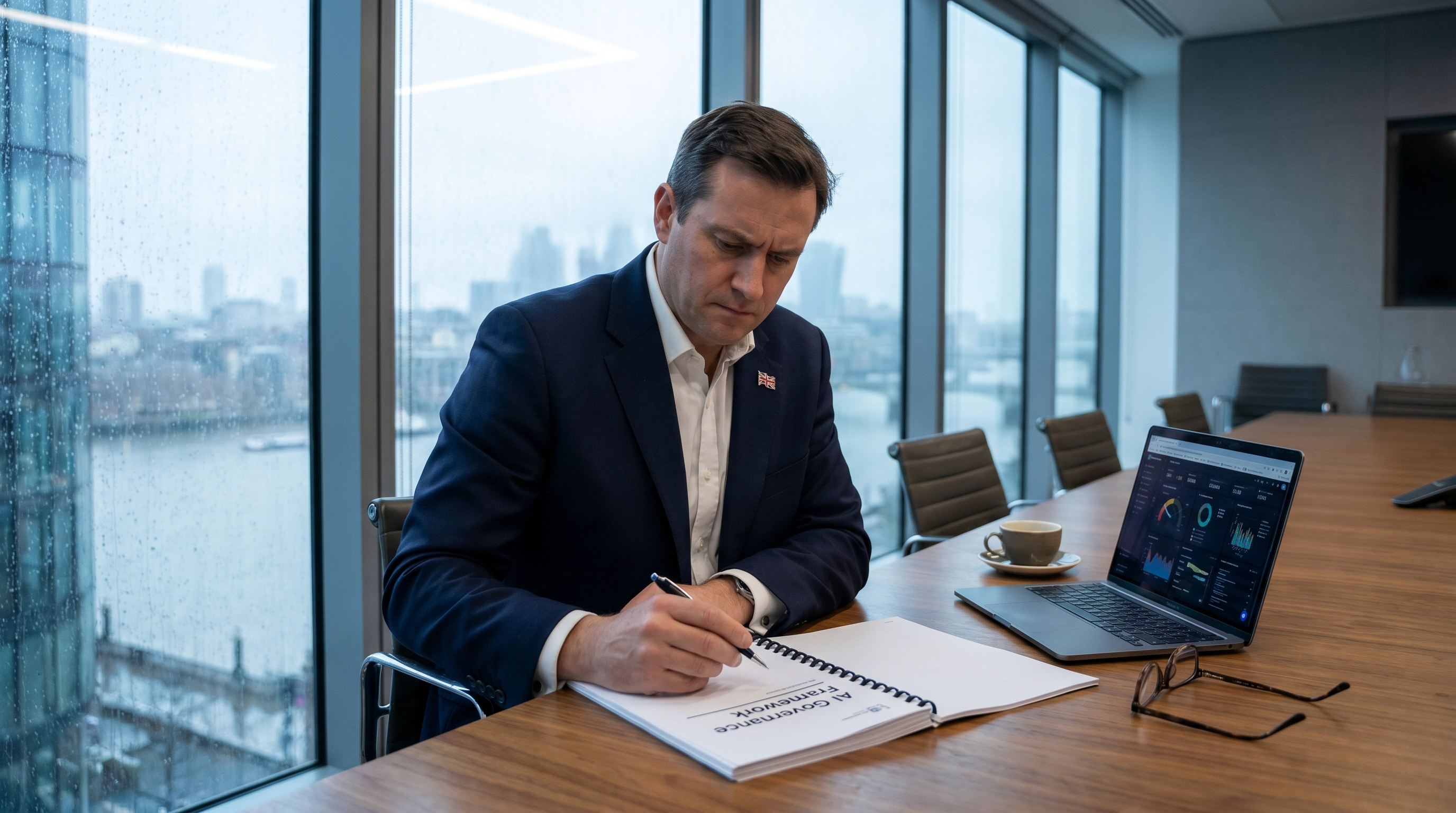
What AI governance actually means
AI governance is the set of structures, policies, and accountabilities that determine how AI is used within a business. It answers three questions that most AI adoption frameworks never ask.
First: who is responsible for the outputs this AI system produces? Not the software vendor. Not the platform. A named human being inside the business, accountable for what the AI does in their name.
Second: where is this AI system permitted to operate? Not everywhere. Not wherever it seems useful. In specific, defined functions — where the business has confirmed that AI belongs, that the operating position is stable, and that governance structures are in place.
Third: what happens when the AI produces an error? Not a general policy. A specific, tested response: who identifies the error, who corrects it, who is accountable for the downstream consequences, and how the system is paused or overridden when needed.
For UK SMEs, AI governance means having clear answers to all three questions before any AI system is introduced — not after something goes wrong.
Why governance is a commercial requirement, not a compliance exercise
The framing of AI governance as a compliance matter is one of the most damaging ideas in the current AI adoption conversation. It positions governance as a cost — something you do to satisfy a regulator, not something that protects the business.
For UK SMEs, the commercial case for AI governance is straightforward. A business that deploys AI without governance has delegated consequential decisions to a system it cannot fully explain, override, or hold accountable. When that system produces an error — and it will — the business has no clear accountability structure, no tested override mechanism, and no documented basis for the decision that led to the error.
That is not a compliance problem. That is an operational and commercial problem. It creates client risk, reputational risk, and in regulated sectors, legal risk.
Governance is the structure that prevents those risks from materialising. It is not a cost. It is the foundation that makes AI adoption commercially viable.
The three things UK SMEs need before deploying AI
Based on the OSCAR Diagnostic — a structured AI adoption assessment for UK SMEs — there are three governance requirements that must be in place before any AI system is introduced.
The first is a mapped operating position. The business must understand its current state across the domains where AI will operate. Not a general sense of how things work — a structured map of processes, dependencies, decision points, and constraints. AI introduced into an unmapped operating position amplifies existing problems rather than solving them.
The second is a Human Decision Gate. Every AI system that produces outputs with downstream consequences must have a named human accountable for reviewing and authorising those outputs before they cross into the real world. Not a team. Not a policy. A person.
The third is an override capability. The business must be able to pause, correct, or shut down any AI system at any point. This is not a technical requirement alone — it is a governance requirement. The people responsible for the AI system must know how to exercise that override, and the system must be designed to make it possible.
- 1Operating position mapped across relevant domains
- 2Human Decision Gate in place with named accountability
- 3Override capability confirmed and tested
The regulatory context UK SMEs cannot ignore
UK SMEs adopting AI in 2026 and beyond operate in a changing regulatory environment. The EU AI Act is in force, with provisions continuing to phase in through 2026 and 2027. UK businesses that operate in EU markets, use EU-based AI systems, or process EU citizen data may be subject to its requirements.
The UK's own AI regulatory framework is developing. The ICO has published guidance on AI and data protection. The FCA has issued AI-specific guidance for regulated sectors. Sector regulators are each developing their own positions.
The direction of travel is consistent: obligations are increasing, not decreasing. Businesses that establish governance structures now are building the foundation that future regulatory requirements will expect to see. Businesses that defer governance until regulation forces it will be retrofitting structures into systems that were never designed to accommodate them.
For UK SMEs, the practical implication is clear: governance is not something to add later. It is something to build in from the start.
Where to start
The right starting point for AI governance is not a policy document. It is a diagnostic.
The OSCAR Diagnostic maps the current operating position of a UK SME across nine domains before any AI implementation is recommended. It identifies where AI genuinely belongs in the business, where governance gaps exist, and what the right sequence of change is. It produces a founder-reviewed output that gives the business a clear picture of its readiness — and a structured path forward.
Governance starts with understanding the current state. Not with deploying a tool and hoping the governance catches up.