
The reprieve — and what it does not change
In May 2026, a political agreement under the EU’s Omnibus process extended the enforcement dates for high-risk AI systems. The original deadline of 2 August 2026 has been pushed back — to December 2027 for standalone high-risk systems and August 2028 for those embedded in regulated products. For businesses that were watching that August date with anxiety, this is a genuine reprieve.
But it is not a clean slate.
The prohibitions on unacceptable-risk AI have been enforceable since February 2025. These cover AI systems that use subliminal manipulation, infer emotions in workplaces or educational settings outside medical contexts, or exploit vulnerable groups. These are not future concerns. They are live, and the fines attached to them — up to €35 million or 7% of global annual turnover — are enforceable now.
Also live since February 2025: the AI literacy obligation. Every organisation that uses or deploys AI must ensure the people operating those systems have a sufficient level of AI literacy. Not training for training’s sake. Genuine, documented competence. This is a legal obligation today.
In parallel, the UK Information Commissioner’s Office is finalising its statutory Code of Practice on AI and automated decision-making, expected in Summer 2026. This is not guidance. It is a statutory instrument. Non-compliance is directly actionable under the UK GDPR framework. The ICO has already signalled that automated decision-making — particularly in hiring, credit, and customer service — will be a priority enforcement area.
The reprieve on high-risk enforcement is real. The broader regulatory environment is not waiting. Any UK business that operates in EU markets, processes data from EU citizens, or deploys AI systems that interact with EU customers remains within scope. The Act does not require a business to be incorporated in the EU. It requires that the AI system’s output affects someone in the EU.
High-risk AI enforcement extended: December 2027 (standalone) / August 2028 (embedded).
Unacceptable-risk AI prohibitions: enforceable since February 2025.
AI literacy obligation: live now.
ICO statutory Code of Practice on AI: Summer 2026.
The accountability vacuum
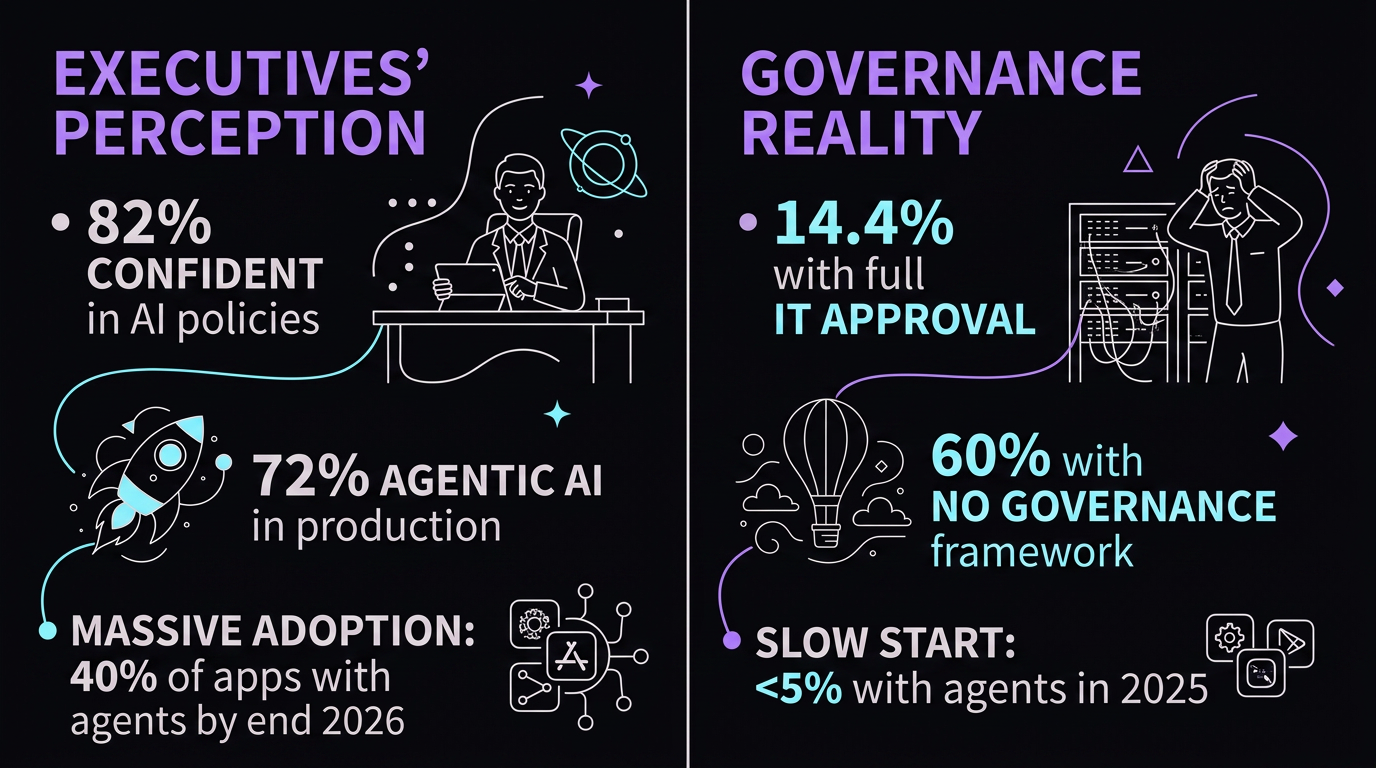
The data on AI governance ownership is not encouraging. Only 28 per cent of CEOs have formally taken ownership of AI governance in their organisations. Only 17 per cent of boards have assigned it as a named board-level responsibility. And 42 per cent of AI initiatives launched in 2024 and 2025 were abandoned before completion — not because the technology failed, but because the governance infrastructure to support them was not in place.
This is not a technology problem. It is a structural one. Businesses have been deploying AI tools into environments where no one has formally answered four questions: Who is responsible for this system? What is it permitted to do? Who has authority to override it? And what controls exist to detect and respond when it goes wrong?
Those four questions — Role, Scope, Authority, Control — are the structural dimensions of governed AI. They are not abstract governance theory. They are the minimum architecture that any AI deployment requires to be defensible under either the EU AI Act or the ICO Code. A business that cannot answer them for each AI system it operates is not ungoverned in a philosophical sense. It is ungoverned in a legal one.
- 1Role: Who is formally responsible for this AI system?
- 2Scope: What is this system permitted to do, and what is it explicitly not permitted to do?
- 3Authority: Who has the authority to override, pause, or decommission this system?
- 4Control: What mechanisms exist to detect errors, flag anomalies, and trigger human review?
The Human Decision Gate as regulatory requirement
The Human Decision Gate is the point in any AI-assisted workflow where a human reviews, approves, or overrides the AI output before it becomes a business decision or action. Human Heartbeat AI has described it as a governance principle since the organisation’s founding. It is also, under both the EU AI Act and the ICO Code, a regulatory requirement — and the extended enforcement timeline changes nothing about that.
The EU AI Act’s provisions for high-risk systems require that humans remain in meaningful control of consequential decisions. The ICO Code requires that individuals subject to automated decisions have access to human review. Both instruments are pointing at the same structural requirement: AI systems must not make consequential decisions autonomously. A human must be in the loop, with genuine authority to change the outcome.
The extended enforcement dates give businesses more time to build the formal compliance architecture. They do not give businesses permission to continue deploying AI without human oversight. The obligation to govern is already live. The extended deadline is an opportunity to do it properly — not a reason to defer.
The minimum compliance stack for UK SMEs
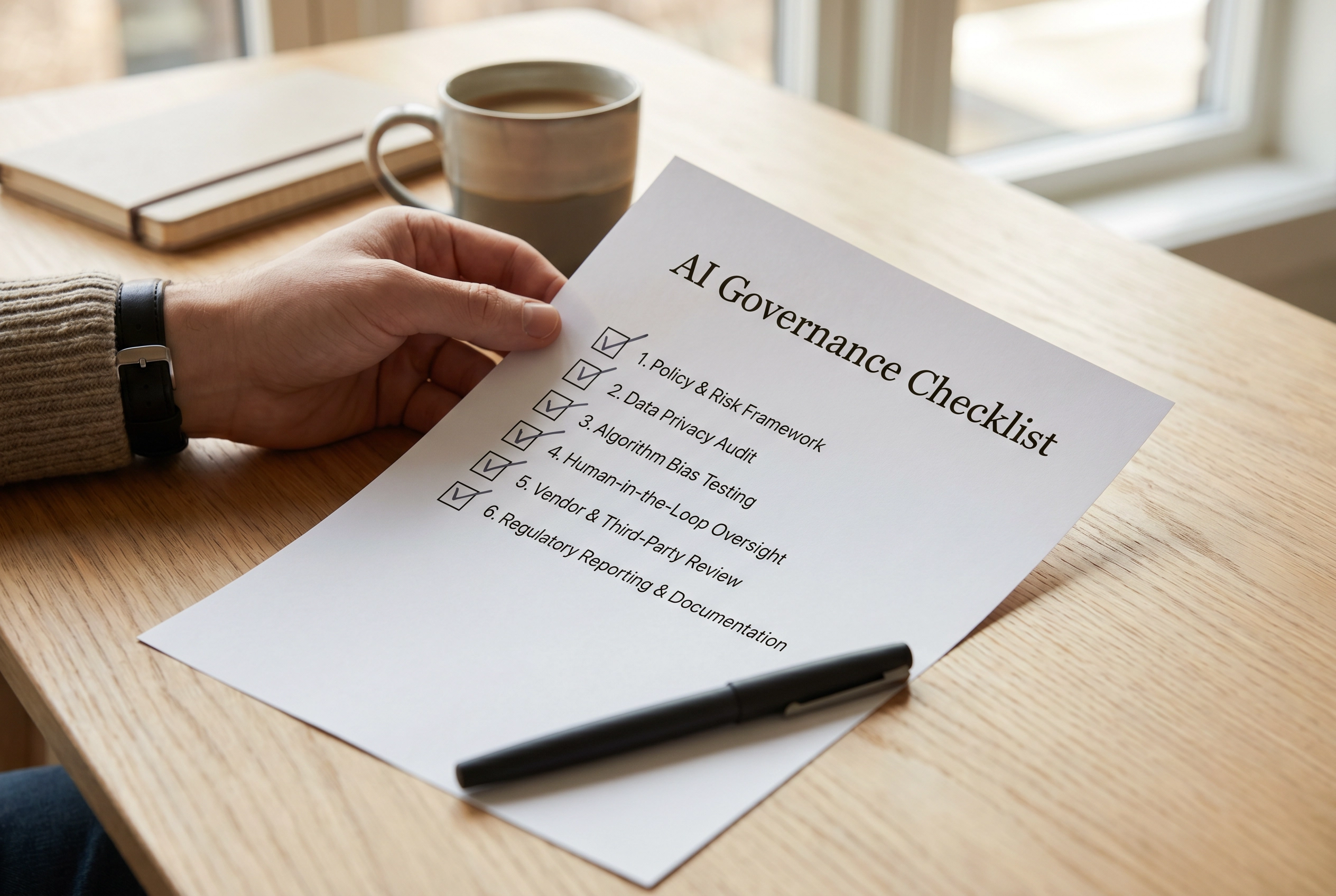
The compliance requirements are serious. They are not, however, unmanageable for a well-organised SME. The minimum stack is six elements, and none of them require significant technology investment.
First, an AI register: a documented inventory of every AI system the business uses, including third-party tools, with a brief description of what each system does and what data it accesses. Second, a named risk owner: a specific individual — not a team, not a function — who is formally accountable for AI governance decisions. Third, a quarterly review forum: a structured meeting, at minimum quarterly, where the AI register is reviewed, incidents are discussed, and governance decisions are recorded. Fourth, vendor due diligence: a documented process for assessing AI tools before adoption, including questions about training data, bias testing, and data handling. Fifth, staff training: a minimum baseline of AI literacy for anyone who uses or manages AI tools, covering what the tools can and cannot do and how to escalate concerns. Sixth, an incident response protocol: a documented process for what happens when an AI system produces an incorrect, harmful, or unexpected output.
None of these require a dedicated AI team. They require a founder or senior leader who has taken the time to understand the landscape and made a deliberate decision to build the structure. That decision is what separates a governed business from an ungoverned one.
- 1AI register: documented inventory of all AI systems in use.
- 2Named risk owner: a specific individual formally accountable for AI governance.
- 3Quarterly review forum: structured meeting to review the register and record decisions.
- 4Vendor due diligence: documented process for assessing AI tools before adoption.
- 5Staff training: baseline AI literacy for all users and managers of AI tools.
- 6Incident response protocol: documented process for unexpected or harmful AI outputs.
OSCAR before the deadline
The OSCAR Diagnostic was designed for exactly this moment. Not because the regulatory environment was anticipated with precision, but because the underlying problem — businesses deploying AI without understanding where their decisions, data, and accountability sit — was always going to create exposure. The regulation has arrived to formalise what was already a structural risk.
OSCAR maps nine areas of a business and produces three outputs: where AI can genuinely help, where AI may expose the business, and what must be governed before any further deployment. It is not a compliance audit. It is a diagnostic. It gives the people responsible for the business the honest picture they need to make considered decisions.
The extended high-risk enforcement timeline is a gift. It is time that most businesses did not expect to have. The businesses that use it well — to build the register, name the owner, map the decisions, and install the gates — will enter the enforcement period with a defensible position. The businesses that treat the extension as permission to wait will find themselves in exactly the same position in 2027 that they are in today, except with less goodwill from regulators who expected preparation to have happened.
That preparation starts with OSCAR.