AI has moved. Most businesses have not noticed the shift.
For the last few years, AI mostly helped people produce things faster.
Write a draft. Summarise a document. Generate an image. Prepare a report. Compare a few options.
The human still decided what to do with the output.
That line is now moving.
AI is beginning to sit inside workflows, not just beside them. It can route customer enquiries, score leads, prepare payment runs, rank candidates, draft supplier responses, recommend next actions and trigger operational steps. In more advanced setups, AI Workers may prepare or carry out sequences of work that previously relied on human coordination.
The question is no longer whether AI is useful. It clearly is.
The better question is: where does human judgement still sit before AI-supported output becomes business action?
That is what a Human Decision Gate answers.
A Human Decision Gate is not just "human in the loop"
"Human in the loop" has become one of the most overused phrases in AI adoption.
It sounds reassuring. It suggests someone is still in control. It gives the impression that human judgement remains present.
But in many business processes, it means very little.
It may mean someone receives a notification. It may mean there is a confirmation button. It may mean someone could check the output if they had time. It may mean responsibility has been pushed onto a human without giving them the information needed to make a real decision.
That is not enough.
A Human Decision Gate is more specific.
It is a defined point inside a business process where a named person, with sufficient context, evidence and authority, actively decides whether an AI-supported recommendation should become action.
The difference is precision.
"Human in the loop" is a broad principle. A Human Decision Gate is an operating design.
It has a location. It has an owner. It has required information. It has a decision standard. It has a clear line between what AI prepared and what the human approved.
That is the difference between assumed oversight and real judgement.
What must be visible before the human decides?
A click is not a decision.
A decision requires understanding.
Before a Human Decision Gate can function properly, the person making the call needs to see enough to judge the recommendation, not simply approve the output.
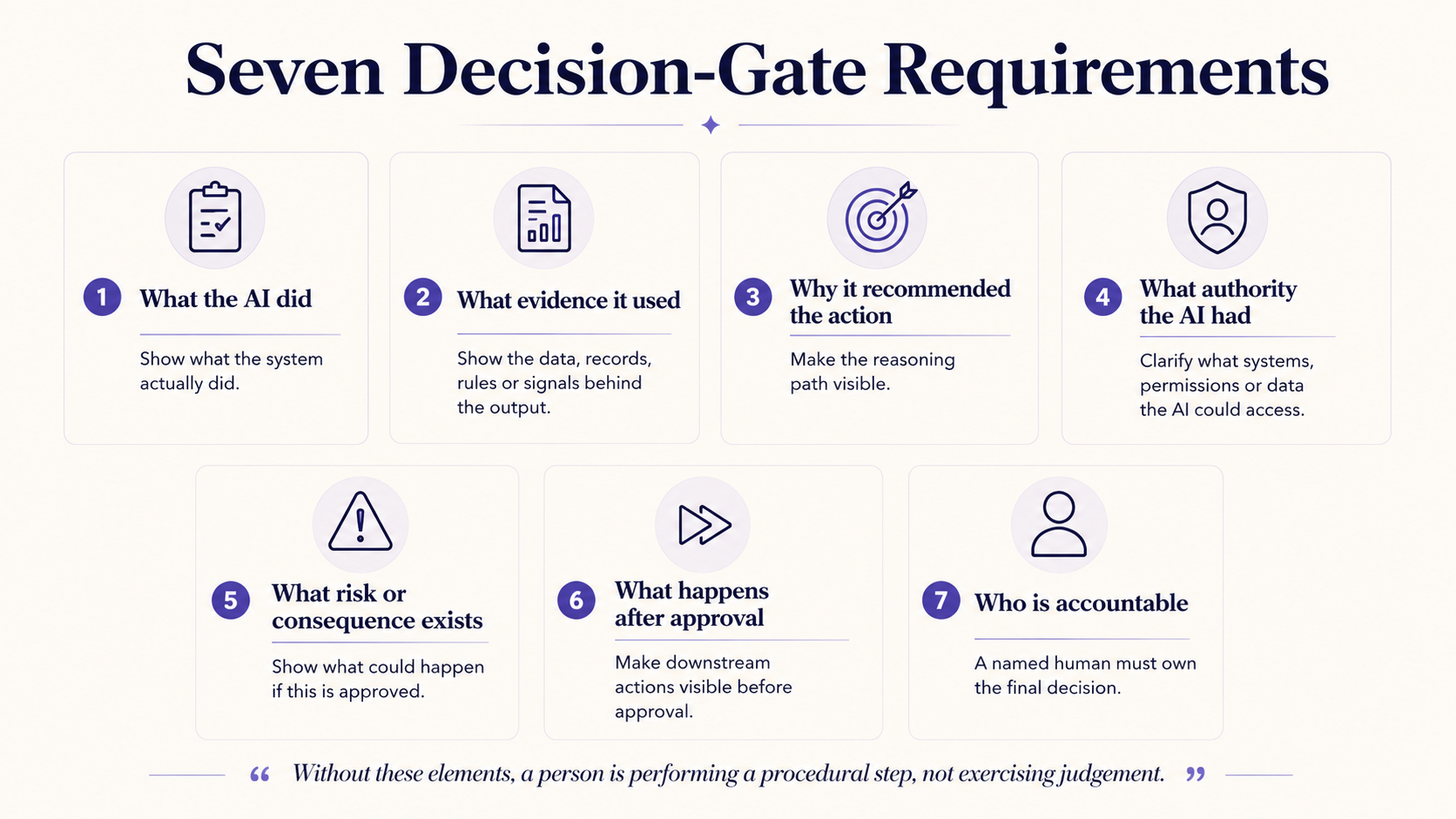
At minimum, seven things should be visible.
1. What the AI did — The reviewer needs to know what the AI actually did. Did it summarise? Score? Rank? Draft? Filter? Recommend? Prepare an action? Trigger a workflow?
2. What evidence it used — The person needs to know what data, records, documents, customer history, rules or signals informed the output. Weak evidence produces weak decisions, even when the AI sounds confident.
3. Why it recommended the action — The reviewer should understand the reasoning path. If an AI ranked one supplier, lead, candidate or customer response above another, the human needs to know why.
4. What authority the AI had — Authority defines exposure. Did the AI have access to financial records, customer data, pricing rules, internal notes, supplier details, operational systems or communication history?
5. What risk or consequence exists — If approved, what happens? Who is affected? What financial, operational, relational or reputational consequence could follow?
6. What happens after approval — Approval must not launch an invisible chain of downstream actions. The person at the gate needs to know what their decision will set in motion.
7. Who is accountable — The owner of the decision gate must be clear. Not "the team." Not "the system." A named role or person whose judgement stands behind the decision.
Without those elements, the human is not exercising judgement.
They are performing a procedural step.
Where Human Decision Gates matter most
For UK SMEs, these moments appear faster than most owners realise.
They are not limited to advanced AI systems. They can appear anywhere AI begins to influence work that carries consequence.
Sales recommendations — AI may score inbound leads, prioritise outreach or draft proposal language. A Human Decision Gate ensures the commercial judgement still reflects what the business actually knows about the customer, not only what the AI inferred.
Customer service triage — AI may categorise enquiries, suggest urgency levels or prepare responses. A gate matters when the issue is sensitive, unusual, emotionally charged or commercially important.
Complaint handling — An AI-prepared response may be factually neat but commercially clumsy. A Human Decision Gate allows someone with customer knowledge and business judgement to review the proposed outcome before it becomes the official response.
Payments and renewals — AI may prepare renewal notices, invoice instructions or payment-related communications. Human review matters before anything is sent, approved or relied on.
Supplier choice and procurement — If AI compares suppliers or ranks options, the final decision should still pass through a human who understands business priorities the AI may not fully know.
Recruitment and staff decisions — AI may support shortlisting, scheduling or candidate comparison. But no person should be advanced, rejected or disadvantaged purely because an AI-shaped process made it easy to do so.
Pricing and discounts — AI may prepare pricing suggestions, margin checks or discount recommendations. A Human Decision Gate keeps commercial control with the business.
AI Worker task execution — Where AI Workers prepare or carry out multi-step work, there must be a defined gate before execution begins, at key checkpoints, or before a result is committed.
Operational workflow changes — If AI recommends changes to how the business operates, those changes should not quietly become the new process without human review.
The pattern is simple: if the AI-supported output affects money, customers, staff, suppliers, reputation, operations or trust, a Human Decision Gate should be considered before action.
AI can still do useful work
This is not an argument against AI.
It is an argument for designing AI into a business deliberately.
AI is highly valuable when it prepares the ground for better human decisions. It can draft, summarise, analyse, compare, flag, classify, structure, research and recommend. Used well, it reduces preparation time and improves the quality of information available to the person making the decision.
That is the point.
AI should make the human decision better informed, not quietly remove the need for the human decision.
There is no contradiction between using AI extensively and maintaining Human Decision Gates.
The strongest businesses will do both.
They will use AI to improve speed, preparation and intelligence — while keeping clear control over the decisions that carry consequence.
Why a confirmation click is not enough
Most approval interfaces are designed for speed.
A green button. A brief summary. A yes/no prompt. A "confirm" screen.
That may satisfy a workflow requirement. It does not necessarily create human judgement.
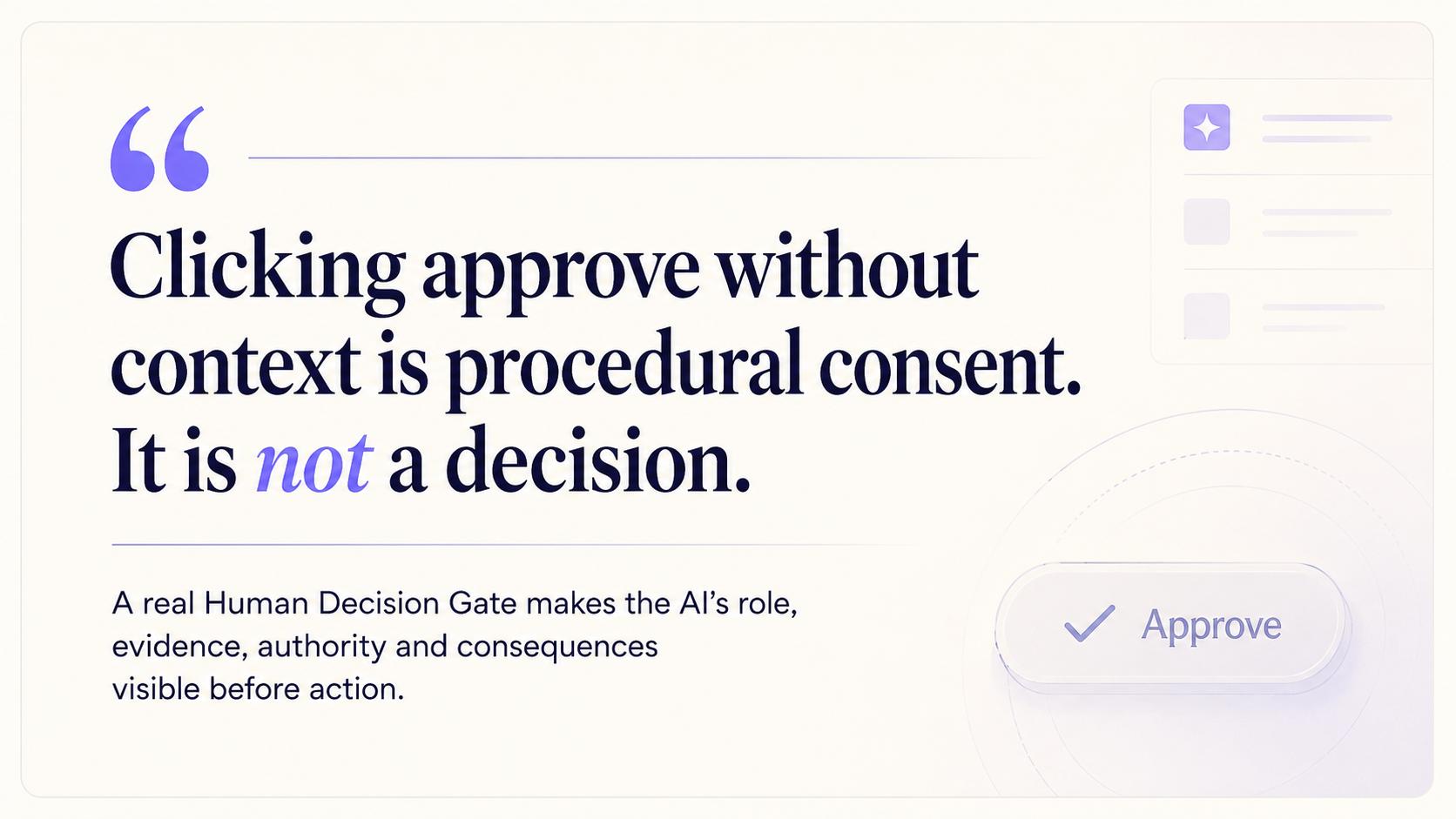
Clicking approve without context is procedural consent. It is not a decision.
This matters because many businesses will believe they have kept a human involved simply because a person clicked something before the action happened. But if that person could not see what the AI did, what evidence it used, why it recommended the action, what authority it had, and what would happen next, the approval was weak.
It may create a record that says a human was involved.
It does not prove that human judgement was active.
A real Human Decision Gate requires the system, process or interface to make the right context visible before approval.
That is not a nice-to-have.
It is the difference between meaningful oversight and performative oversight.
Human Decision Gates are commercial infrastructure
Governance is often treated as friction.
Something that slows the business down. Something that adds bureaucracy. Something that gets in the way of efficiency.
But a Human Decision Gate, properly designed, does the opposite.
It protects trust because customers, staff and suppliers know human judgement remains active where it matters.
It protects accountability because material decisions have a visible owner.
It improves speed because people are not forced to rework decisions made from weak or hidden context.
It supports AI adoption because the business can expand AI use without losing clarity over authority.
A Human Decision Gate is not a bureaucratic checkpoint.
It is commercial infrastructure.
It is how a business keeps its decision-making capability intact as AI becomes part of more workflows.
It protects trust.
It protects accountability.
It improves speed.
It supports AI adoption.
Why this should be mapped before implementation
Many SMEs run on experience, habit and informal judgement.
That is not a criticism. It is how many good businesses work.
The founder knows when to step in. The office manager knows which customer needs care. The salesperson knows when a lead is not as strong as it looks. The operations lead knows when a process exception matters.
Much of that judgement is real, but undocumented.
When AI enters the business, that hidden judgement needs to become more visible.
Who currently makes which decisions? On what basis? With what information? With what authority? What happens when the decision is wrong? Where does human review already happen informally? Where would AI change the decision pathway?
If those questions are not asked before implementation, AI can quietly fill the space where human judgement used to sit.
Not because anyone intended to hand over control.
Because no one mapped the decision points before adding automation.
That is why diagnosis comes before implementation.
Before a business introduces AI Workers, automation or AI-supported workflows, it needs to understand where decisions already happen, where AI may assist, and where Human Decision Gates must be defined.
The OSCAR Diagnostic exists for that pre-implementation moment. It helps a business see where AI, people, processes, data and governance meet before decisions are redesigned around technology.
That is not about slowing AI down.
It is about making sure the business knows where the line sits before AI starts crossing it.
Closing position
AI can prepare. AI can analyse. AI can summarise. AI can rank. AI can route. AI can recommend.
In each of those roles, it can add real value.
But where business action carries consequence, human judgement still needs a visible place to stand.
That place is the Human Decision Gate.
It is not anti-AI. It is not fear of technology. It is not bureaucracy dressed up as responsibility.
It is the point where the business says: AI may support the work. AI may prepare the recommendation. AI may improve the evidence. But where the decision matters, a human being must still understand it, own it and make the final call.
That is what governed AI adoption looks like in practice.
AI can prepare.
AI can analyse.
AI can summarise.
AI can rank.
AI can route.
AI can recommend.