
The disclosure gap nobody is talking about
Most conversations about AI transparency stop too early.
They focus on disclosure.
Was AI used? Was it acknowledged? Did the business tell people somewhere in the process?
Those are fair questions. They are not enough.
A business can say AI was involved in customer emails, lead prioritisation, complaint handling, payment preparation, supplier ranking or internal admin — and still have no clear view of what AI actually did.
That is the gap.
Knowing that AI was present is not the same as understanding how it shaped the decision.
For UK SMEs, this matters because AI is no longer only producing content at the edge of the business. It is moving into workflows. It can influence which customer gets attention first, which supplier is preferred, which complaint is escalated, which renewal is prepared, which task is routed, and which recommendation reaches a human for approval.
That means the real question is changing.
Not just: Was AI used?
But: What did AI do, why did it do it, and where did human judgement enter before action was taken?
That is the decision transparency problem.

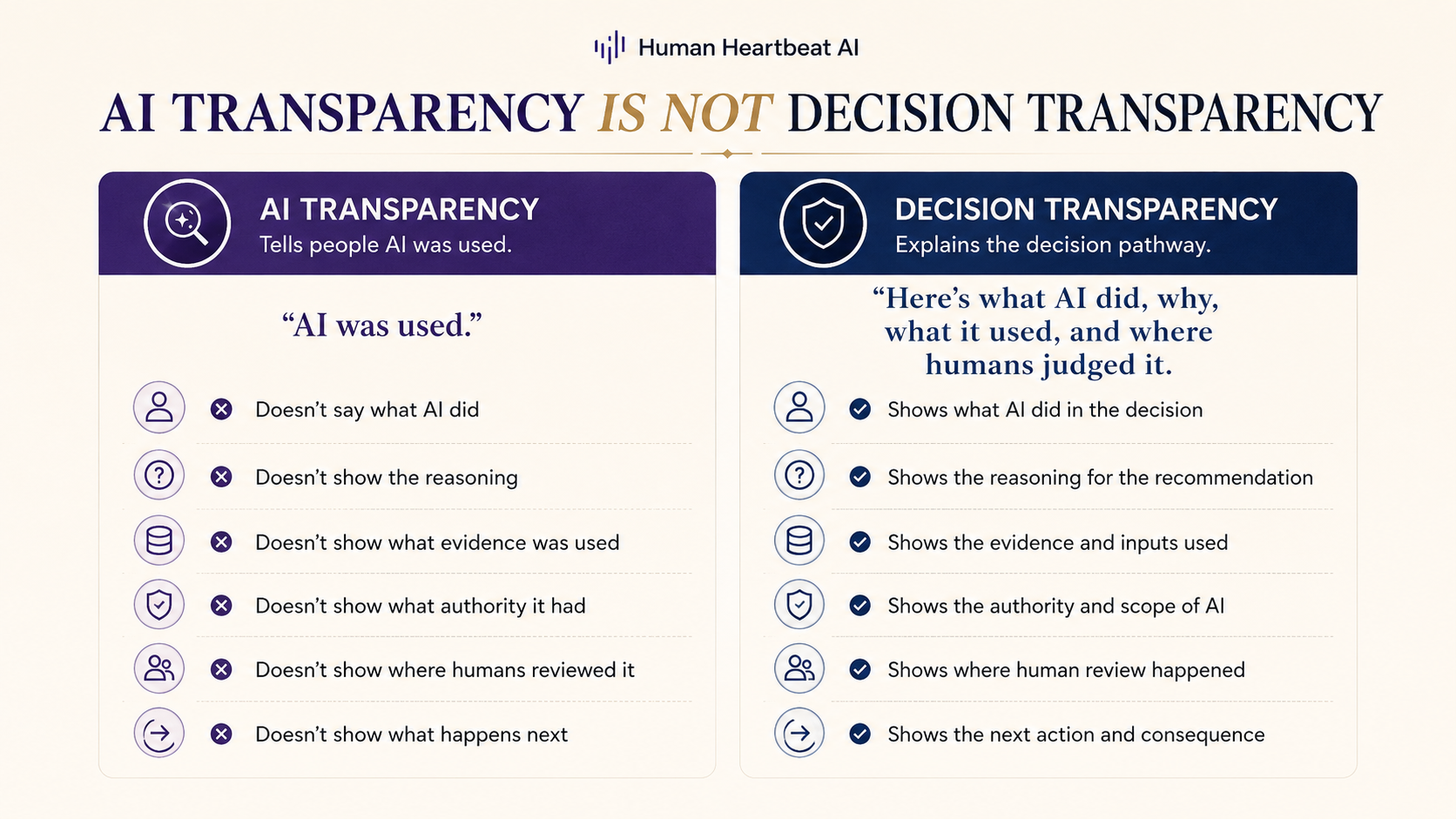
"AI was used" tells us almost nothing
The phrase "AI was used" sounds open.
In practice, it often tells us very little.
It does not say whether AI advised, ranked, filtered, drafted, compared, routed, escalated, rejected, prepared or triggered an action.
It does not say what information the AI worked from.
It does not say what evidence was missing.
It does not say whether the recommendation was based on strong data, partial data, old data, biased data, or a narrow optimisation goal.
It does not say what authority the AI had inside the business.
It does not say whether a human reviewed the recommendation with enough context to make a real decision.
For low-consequence work, that may be acceptable. If AI helps draft a paragraph, format a document, summarise notes or prepare a simple first version, the human can usually inspect the output directly.
But when AI influences a business decision, vagueness becomes risk.
Who gets prioritised for outreach? How is a complaint answered? Which supplier is recommended? What renewal communication is prepared? What customer is escalated? What task does an AI Worker prepare next?
In those situations, "AI was used" is not transparency. It is a label.
A label may disclose presence.
It does not explain influence.
What decision transparency actually means
Decision transparency is not about exposing every technical detail of an AI model.
Most SME owners do not need to understand model architecture, training pipelines or technical parameter choices before they can run their business responsibly.
They need something more practical.
They need a clear enough view of the decision pathway to understand, review, challenge and stand behind the recommendation.
There is a simple distinction:
AI transparency asks: Was AI used?
Decision transparency asks: What did AI do in this decision, what did it use, why did it recommend this action, what authority did it have, and where did a human judge it before action happened?
That is the commercially useful version.
Technical transparency matters in the right context. Regulators, developers, vendors and auditors may need deeper technical artefacts.
But inside a working SME, the owner, manager, salesperson, operations lead or service team usually needs decision-path transparency.
They need to know what role AI played in the actual business moment.
Because the business is not accountable for an abstract AI system.
It is accountable for the decisions it allows that system to shape.
What must be visible in an AI-assisted decision
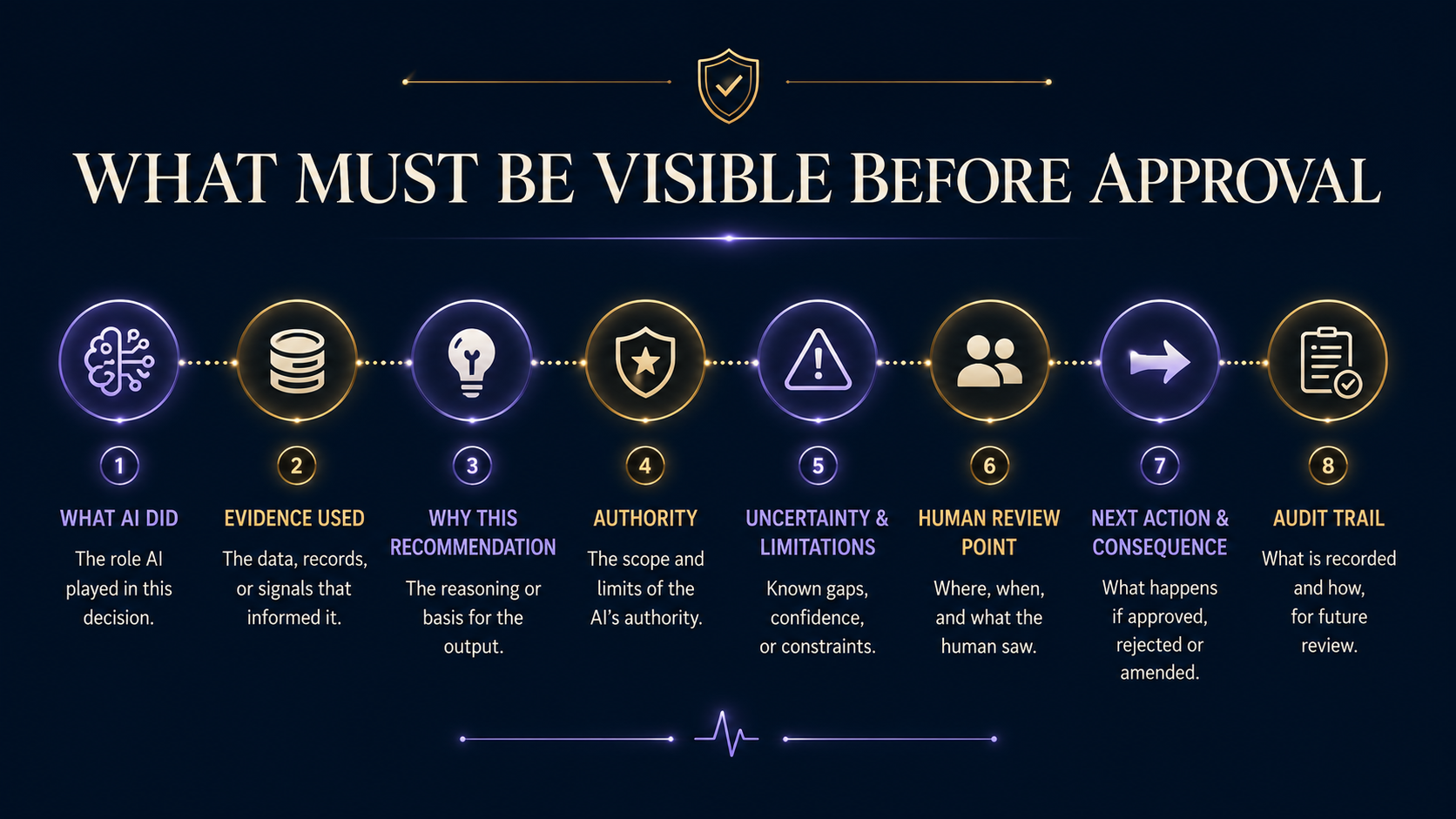
For decision transparency to be real, several things must be visible before an AI-assisted decision becomes action.
1. What the AI did — The verb matters. Did it rank, draft, filter, compare, flag, route, summarise, score, recommend or prepare an action? "Used AI" is too vague.
2. What evidence it used — The reviewer needs to know what data, records, customer history, supplier information, documents, rules or signals shaped the output.
3. Why it recommended or prepared the action — The reasoning path must be understandable enough to challenge. If AI ranked one option above another, the human needs to know what drove that ranking.
4. What authority it had — Authority defines exposure. Did the AI only suggest wording, or did it access customer records, pricing rules, operational systems, financial data or communication history?
5. What uncertainty or limitation existed — Was the AI working from incomplete data? Did it miss something? Was confidence low? Were there constraints it could not assess?
6. What consequence may follow — If the recommendation is approved, what happens next? Who is affected? What financial, operational, reputational or relational consequence could follow?
7. Where human review happened — Not merely that a human was "in the loop," but where they reviewed, what they saw, and what they decided.
8. What action comes next — Approval must not trigger invisible downstream steps. The reviewer needs to know what their decision will set in motion.
9. What audit trail exists — Who decided, when, on what basis, and with what evidence visible at the time?
This is not bureaucracy.
It is the minimum visibility required for AI-assisted decisions to remain understandable.
Without it, the business may still be moving quickly.
But it is moving with poor sightlines.
Why Human Decision Gates need decision transparency
Article 002 defined a Human Decision Gate as the point where a person has enough context, evidence and authority to approve, reject, amend or escalate an AI-supported recommendation before it becomes business action.
The critical phrase is: enough context.
That context does not appear automatically.
It has to be designed into the workflow.
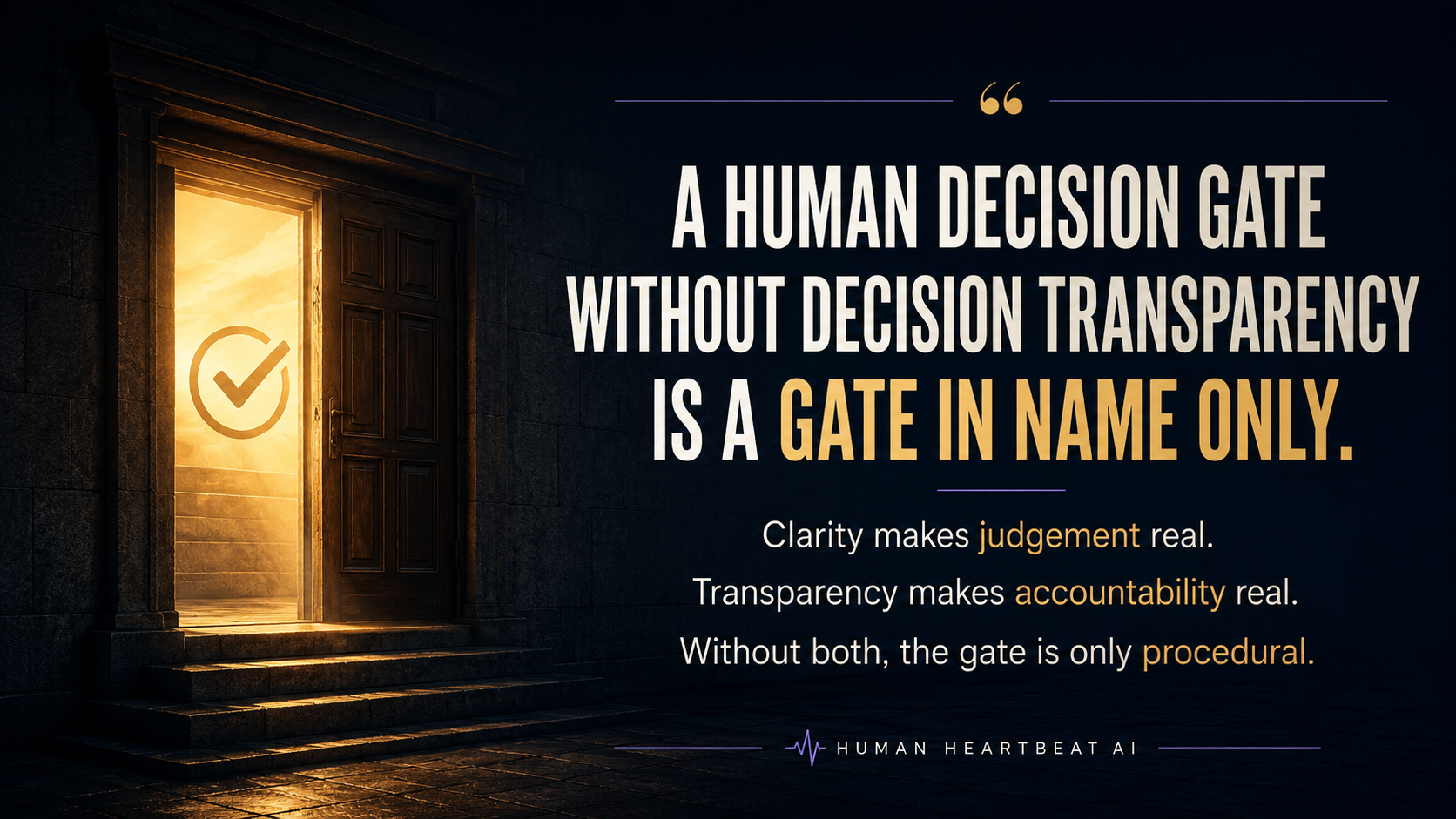
A Human Decision Gate without decision transparency is a gate in name only.
The person may be present. They may be responsible. They may even click approve.
But if they cannot see what the AI did, what it used, why it recommended the action, what authority it had, and what will happen next, their review is weak.
They are not exercising judgement.
They are completing a procedural step.
That is how businesses can believe they have kept humans in control while the real decision pathway becomes increasingly machine-shaped and increasingly hard to explain.
The gate exists.
The visibility does not.
And without visibility, the gate becomes a rubber stamp.
Where decision transparency matters most in SMEs
Decision transparency is not only a concern for large enterprises, regulated sectors or advanced AI teams.
It matters in everyday SME operations.
Sales and lead prioritisation — If AI recommends which leads to pursue first, the salesperson should know why. Was the ranking based on budget, behaviour, sector, engagement, geography, previous enquiries or something else? A lead score without context can send attention in the wrong direction.
Customer service triage — If AI categorises enquiries or suggests urgency levels, the team needs to see the basis for that routing. A customer issue may look routine to the system but carry commercial or relational risk a human would recognise.
Complaint handling — If AI drafts a complaint response, the reviewer needs to see what history, policy, tone and risk factors shaped the answer before it becomes the business's official position.
Payments and renewals — If AI prepares renewal notices, invoice instructions or payment-related communication, the authoriser needs visibility on what is being sent, to whom, on what basis, and what happens if the action is wrong.
Supplier choice and procurement — If AI ranks suppliers, the business needs to know which criteria drove the recommendation. Lowest cost, fastest delivery and best long-term fit are not the same decision.
Recruitment and staff administration — If AI filters, shortlists, compares or routes people-related decisions, the human reviewer must see what signals were used and what was excluded.
AI Worker task preparation — If an AI Worker prepares a multi-step operational task, decision transparency must show what it prepared, why, which sources it used, and where human review is required before continuation or commitment.
Operational workflow changes — If AI recommends changes to process, schedule, routing or resource allocation, the business needs visibility before that recommendation quietly becomes normal operating practice.
The pattern is simple: if AI influences a decision that affects money, customers, staff, suppliers, reputation, operations or trust, the pathway needs to be visible enough for a human to judge it.
Decision transparency is not bureaucracy
Some business owners will hear "decision transparency" and assume paperwork.
More forms. More checklists. More friction. More delay.
That is the wrong version.
Badly designed governance creates friction. Good governance removes hidden friction.
Decision transparency reduces rework because the business can see where the recommendation came from.
It reduces disputes because the decision pathway can be reconstructed.
It protects trust because customers, staff and suppliers are not left dealing with unexplained AI-shaped outcomes.
It protects owners because authority does not drift silently into systems, tools or workflows nobody fully understands.
It improves implementation because the business can see which parts of the process are ready for AI support and which still need human judgement.
It also helps AI adoption scale.
A business that can see its decision pathways can expand AI deliberately.
A business that cannot see them expands by drift.
That is the commercial difference.
Decision transparency is not an administrative layer added to AI.
It is operational infrastructure for using AI responsibly inside a real business.
Why this must be mapped before implementation
Many UK SMEs already have good decision-making.
But much of it is informal.
The founder knows when to step in. The operations manager knows which exception matters. The salesperson knows when a lead score does not tell the whole story. The service team knows when a complaint needs care rather than speed.
That judgement is valuable.
But it is often undocumented.
When AI is introduced into a business like that, the danger is not that every decision immediately becomes automated.
The danger is subtler.
AI begins to influence decisions whose human logic was never mapped in the first place.
If the business does not know where decisions currently happen, it cannot see where AI will touch them.
If it cannot see where AI will touch them, it cannot define Human Decision Gates.
If it cannot define Human Decision Gates, it cannot design decision transparency into the workflow.
And six months later, the owner may not know whether AI is supporting the business's judgement or quietly replacing parts of it.
That is why diagnosis must come before implementation.
Before AI Workers, automation or AI-supported workflows are introduced, the business needs to understand where AI, people, data, process and governance already meet.
The OSCAR Diagnostic is built for that pre-implementation moment.
It helps a business see where decisions currently sit, where AI may influence them, where decision transparency is missing, and where Human Decision Gates need to be designed before implementation begins.
Not as theory.
As operational clarity.
Closing position
AI can recommend, rank, draft, summarise, prepare and flag with genuine commercial value.
But the route from AI output to business action must not disappear into a black box.
A business should be able to see what AI did. It should be able to see what evidence shaped the recommendation. It should be able to see why the action was prepared. It should be able to see where human judgement entered. It should be able to reconstruct what happened afterwards.
That is decision transparency.
AI transparency tells people AI was present.
Decision transparency shows whether human judgement was still real.
And that is the line that matters.