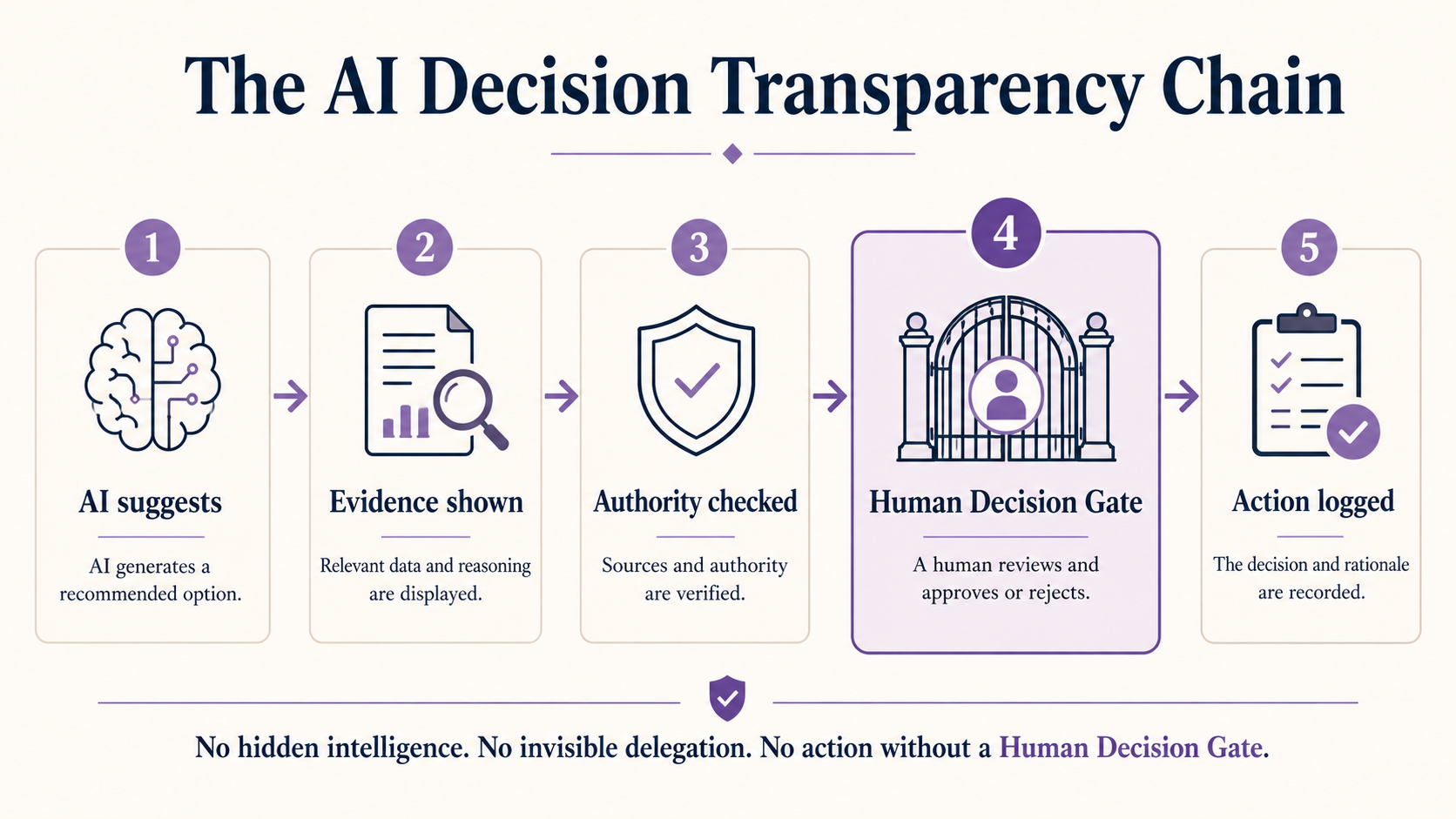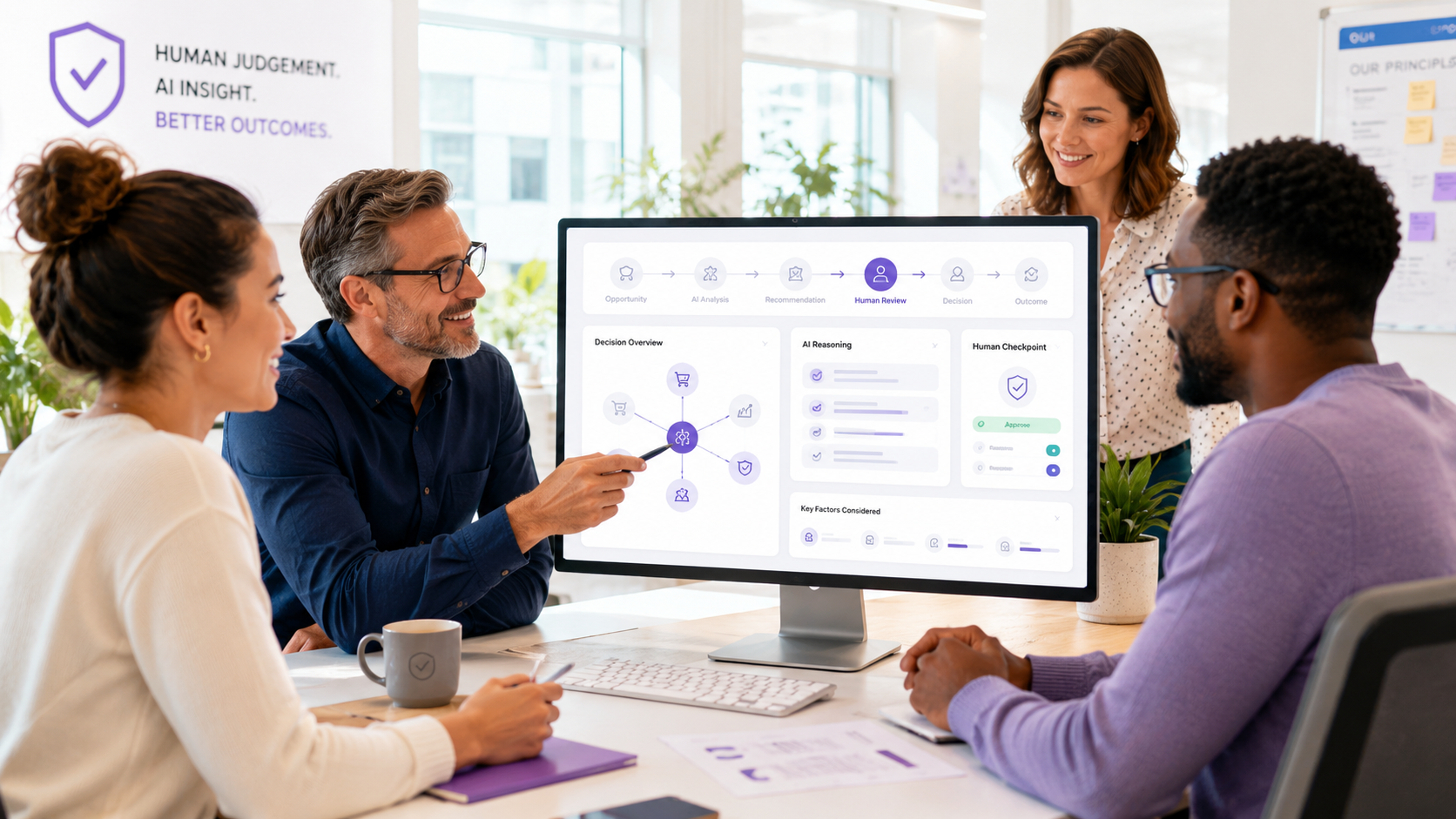
The danger is not the payment. The danger is the invisible decision.
Most people will naturally focus on the payment risk. Can the AI spend too much? Can it buy from the wrong place? Can it be tricked? Can fraud be prevented?
Those are real questions, but they are not the deepest issue.
The deeper issue is what happens before payment.
Before a transaction happens, something has already shaped the decision. Something has selected the options. Something has ranked the suppliers. Something has interpreted the user's need. Something has decided what "best" means. Something has filtered out alternatives. Something has framed the recommendation.
If that "something" is AI, then the real governance issue is not only whether the payment was secure. It is whether the human understood the decision pathway.

"AI helped" is no longer enough
Businesses cannot hide behind vague AI disclosure.
Saying "we use AI" tells people almost nothing.
AI could mean a spellchecker. It could mean a chatbot. It could mean a recommendation engine. It could mean automated triage. It could mean pricing support. It could mean lead scoring. It could mean payment initiation. It could mean supplier selection. It could mean a system that quietly shapes what a customer sees, chooses, accepts or buys.
That is why the next phase of AI governance must move beyond generic disclosure.
The question should not be: "Was AI used?"
The question should be: "What did the AI do?"
Did it advise? Did it recommend? Did it rank? Did it reject? Did it approve? Did it prepare? Did it execute? Did it transact? Did it influence the human's decision?
Those are very different things. And they require very different levels of governance.
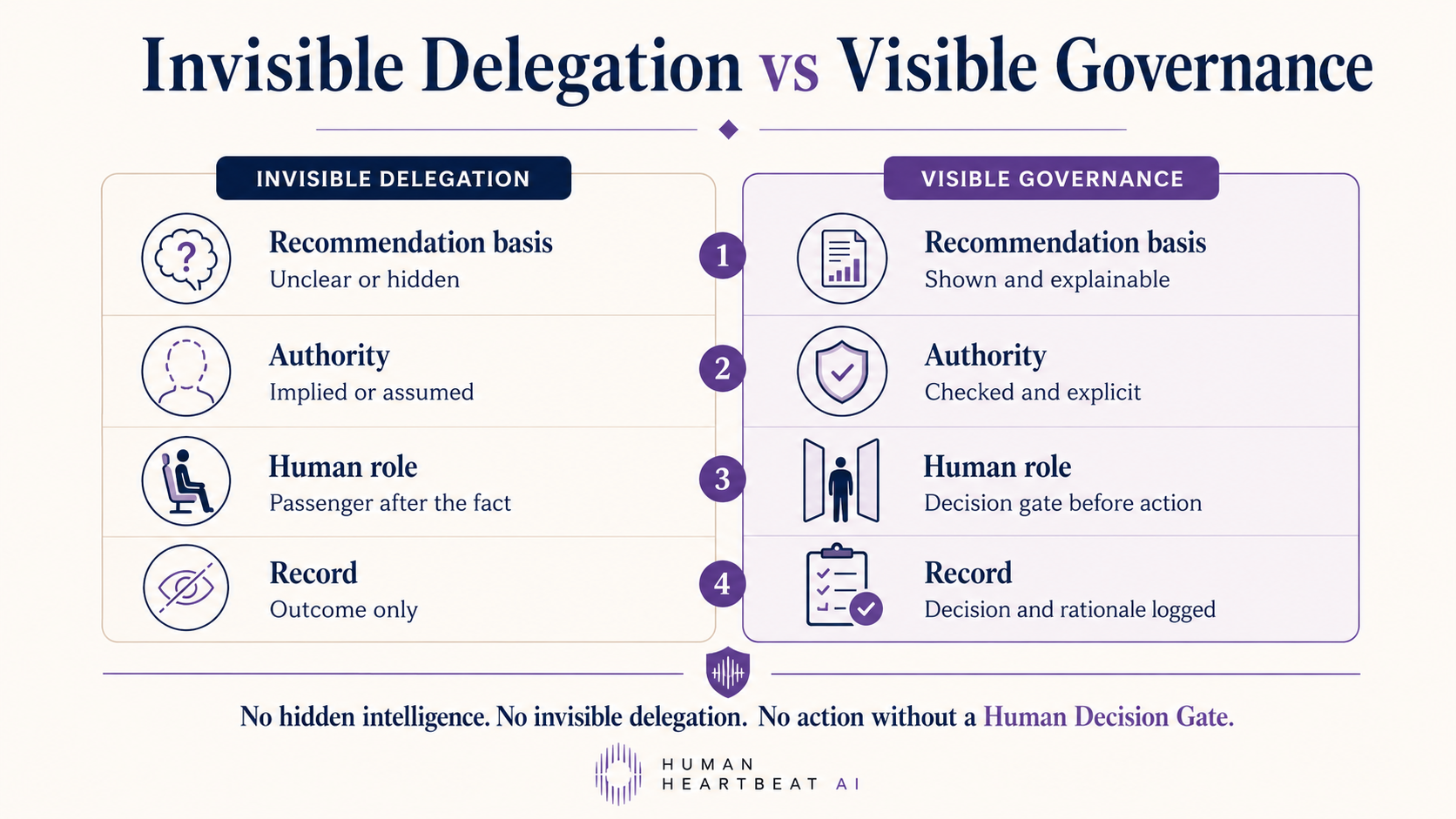
The Human Decision Gate must become visible
At Human Heartbeat AI, our position is simple: AI should support decisions, not silently become the decision-maker.
That does not mean AI should be kept out of commerce. It means AI must be placed inside a governed operating system where its role, limits, evidence and authority are clear.
Every AI-assisted commercial process should answer five basic questions:
1. What did the AI do? 2. Why did it suggest or prepare that action? 3. What information did it rely on? 4. What authority did it have? 5. Where was the Human Decision Gate?
If those five questions cannot be answered, the business does not yet have AI governance. It has AI activity.
And AI activity without governance becomes risk.
- 1What did the AI do?
- 2Why did it suggest or prepare that action?
- 3What information did it rely on?
- 4What authority did it have?
- 5Where was the Human Decision Gate?

The new commercial trust layer
This is not only an ethics issue. It is a business issue.
As AI agents become part of commerce, businesses will need to become understandable to machines without surrendering control to machines.
That means clear offers. Clear policies. Clear terms. Clear data. Clear accountability. Clear approval boundaries. Clear human review points.
Messy businesses will become harder for AI systems to interpret. Unclear businesses may become invisible. Poorly governed businesses may become risky to recommend. Businesses with weak evidence, weak trust signals and unclear processes may lose ground to those that are easier for AI systems to evaluate.
In other words, governance becomes commercial infrastructure.
Not paperwork. Not bureaucracy. Not fear.
Infrastructure.
The businesses that understand this early will have an advantage.
Openness must include the "why"
Transparency cannot stop at telling people that AI exists.
Real openness means explaining the "why".
Why was this product recommended? Why was this supplier selected? Why was this customer prioritised? Why was this applicant rejected? Why was this payment prepared? Why was this renewal suggested? Why was this complaint routed a certain way? Why was this risk flagged?
People do not need every line of technical detail.
But they do need enough explanation to understand whether the AI served their interest, the business's interest, or a hidden optimisation goal they were never told about.
That distinction matters. Because AI can be helpful and commercially biased at the same time.

The policy every serious business now needs
Human Heartbeat AI believes every organisation adopting AI should have an Open AI Decision Policy.
This is not a policy for slowing AI down. It is a policy for making AI-assisted decisions understandable, reviewable and accountable.
That policy should make one commitment clear: no hidden intelligence. No invisible delegation. No action without a Human Decision Gate.
It should define what AI is allowed to do, what it is not allowed to do, when people must be told, what evidence must be retained, and when a human must review before action happens.
This matters most where AI touches money, customers, staff, suppliers, eligibility, pricing, contracts, complaints, operations, or reputation.
Because those are not just "AI use cases". They are business decisions.
And business decisions need accountability.
No hidden intelligence.
No invisible delegation.
No action without a Human Decision Gate.
The future should not be anti-AI. It should be pro-human judgement.
The wrong response to agentic commerce is panic.
The right response is architecture.
AI will increasingly help people search, compare, buy, book, renew, switch, complain, apply, negotiate and transact.
That future is coming.
The question is whether businesses build it around human understanding, or whether humans become passengers in systems they no longer understand.
Human Heartbeat AI stands for a clear principle:
AI can prepare. AI can analyse. AI can recommend. AI can explain. AI can support.
But where a decision affects money, trust, rights, opportunity, reputation or accountability, the human must still be able to understand the decision and hold the final gate.
That is why diagnosis must come before implementation. Before a business gives AI more influence over sales, service, operations, payments, procurement or customer decisions, it needs to understand where AI may assist, where it may recommend, where it may prepare action, and where a human must retain the final decision gate.
Because the future of AI commerce should not be built on invisible delegation.
It should be built on governed intelligence with a human heartbeat.
AI can prepare.
AI can analyse.
AI can recommend.
AI can explain.
AI can support.