I'm going to tell you something that happened to me this weekend, and I want you to sit with it before you decide what it means, because I nearly got the lesson wrong myself.
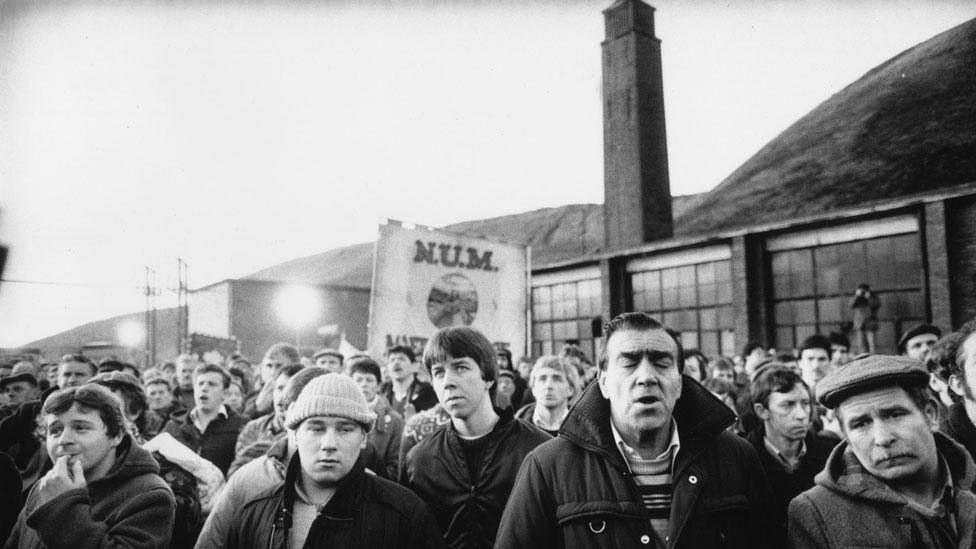
I come from Blaenllechau, in the Rhondda Fach. Growing up, home moved between there, Ferndale, and Penrhys — a council estate built on top of the mountain joining the Rhondda Fach and the Rhondda Fawr, thrown up in the late sixties as a kind of social experiment that everyone living through it could see hadn't worked. My grandfather was a miner. He died of black lung in 1969, in his early sixties, the same year men walked on the moon — two of the biggest events of my whole life, both inside the same twelve months, when I was seven years old. I made a decision that year that I'd never go down a mine myself. I never have. But I've never once stopped respecting every man who did.
They called coal the Black Diamonds down there. I've always liked that — because it says something true most people miss. The valuable thing was never shipped in from somewhere else. It was already under your feet, the whole time, waiting for someone willing to go down and find it.
I finished at Maerdy Comprehensive in 1980, eighteen years old, and that same year my mother, my sister, my brother and I left the Valleys together for Talbot Green. I stayed in Wales, one way or another, right through until my mid-forties. It's only these last twenty-odd years I've properly been away.
I'm telling you all that because it matters to what happened this weekend — not as decoration, but because I think the same thing that was true of the coal turned out to be true of something I built myself, without realising it.
You can't build Z. You have to go and build P, Q, and R first — and you won't know why yet.
Here's the truth of it. Months ago I needed something — call it Y. But Y was no good on its own. Y needed X sat underneath it before it meant a single thing. So I went and built X. Then I needed something to plug into that, so off I went and built P. Then Q. Then R. None of them felt like progress on their own. None of them felt like "the Academy." They felt like plumbing. Boring, disconnected, half-understood plumbing — built because something further down the line was going to need it, even though I couldn't picture that far down the line yet.
I built a payment webhook in May because a diagnostic needed to be paid for eventually. I had no earthly idea in May that it would matter the day my very first client paid for the OSCAR Diagnostic — and the whole thing worked, first time, silently, while I wasn't even watching. I wasn't building "success" in May. I was building P, because Y needed it, because something further off needed Y.
I want to be clear about what that first payment actually proves, because it's not what you might think. It doesn't prove the Academy works. It proves I work — that when I commit to building something properly, piece by piece, it holds up when a real person puts real money on it. That's a different thing entirely, and I'll come back to why that difference matters.
That's the bit that will genuinely test you. It is disorienting. It does not feel like winning. Some days it feels like nothing at all is happening, because from where you're standing, nothing visibly is.
"Is it all ready to pull together yet?"
You cannot ask that question from inside the work. I promise you that. I was head down for months, building P and Q and R, and I had no clue how much I'd actually built. Four months of consistent, disciplined work — six hundred and fifteen separate pieces of progress, if you want the number — and I genuinely did not know it was there. Not roughly. Not a bit of it. I mean I did not know it existed.
What broke it open wasn't planning. It was a completely different, unrelated question — I went looking for something else entirely, a founder page I half-remembered, and in going to find that one small thing, the whole buried system came up with it. That's not coincidence, and it's not luck. That's what happens when you finally stop and turn round to look at what's actually behind you.
That's the moment. Not the building. The turning round.
The weekend didn't build the Academy. The weekend found it.
This is the part I need you to hear properly, because it's the difference between a lesson that helps you and a lesson that sets you up to fail.
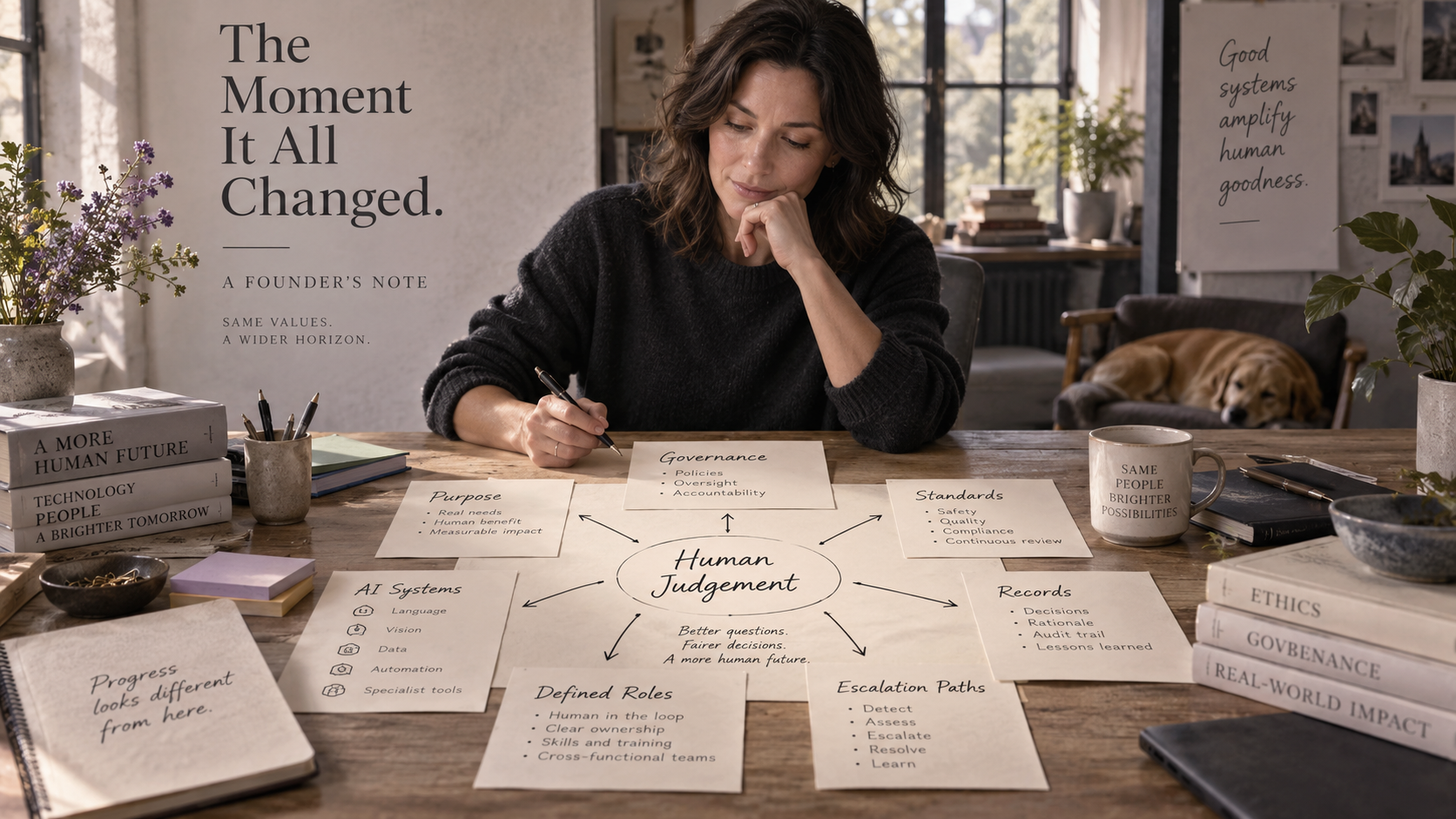
I am not telling you that you can build something real over a weekend. That's a lie, and it's the kind of lie that gets sold to people who don't know better, and it wastes them. What actually happened is this: months of honest, consistent, unglamorous artefact-building — every decision recorded, every standard held the same way twice, every AI conversation treated with the same discipline I'd give a member of staff — all of that sat there, real and solid, waiting. The weekend wasn't creation. It was correct assembly. And assembly done wrong tells you nothing true at all.
I nearly got that wrong too, this weekend, more than once. I nearly accepted "that folder's empty" as fact when it wasn't — it was just the wrong folder. I nearly went chasing a phantom problem that turned out to be something I'd created myself and forgotten. If I'd trusted the first answer I was given, on any of it, I'd have walked away with a false picture — either thinking less existed than actually did, or worse, believing something was broken that never was.
So here's the method, plain, the way I'd teach it to any one of you: Gather every source you've got — don't trust your memory of what you built, go and find the actual record. Cross-check one source against another — never take a single account as the truth, not even your own. When two sources disagree, don't pick the answer that sounds better. Dig until you know which one is actually right.
Write down what you now know to be true, in one place, so it stops being scattered. Then — and only then — decide what it means and what happens next. That's not an AI skill. It's a valleys skill, dressed up in new clothes. Check your work. Trust the evidence, not the story. Don't call the job finished until you've actually walked it end to end.
Your turn
Before you do anything else this week, I want you to go and look. Not plan, not build — look. Every AI thread you've had, every note you've made, every half-finished thing you assumed was still half-finished. Go and gather it in one place, the way I did this weekend. Cross-check it. Don't trust the first summary any tool gives you.
You might find nothing much. That's fine — that's useful too, it tells you where the real work still needs doing. But you might find, the way I did, that you'd already built further than you knew. Go and look. Then come back and tell me what you found.
One more thing, before I finish
I promised I'd come back to why that first payment proves me and not the Academy. Here it is, plainly, because I don't want any confusion sitting under this.
The Academy is not an extension of my consultancy work. It's not a waiting room for OSCAR clients, and it's not something you get sold into after a diagnostic. It stands entirely on its own — its own community, its own path, its own reason for existing, whether or not you ever become a client of mine in any other part of what I do. Human Heartbeat AI does two different jobs. One is working directly with businesses on their AI governance, one relationship at a time. The other is this.
And here's the honest reason the second one exists at all. I can't do the first job for everyone who needs it. There's one of me. I can sit across the table from a business, diagnose what's really going on, walk them through it properly — but I can only do that for so many businesses in a year, and there are far more SME owners out there who need this thinking than I could ever reach one at a time, however hard I worked. If the only thing I ever built was my own time sold hour by hour, I'd hit a ceiling, and everyone past that ceiling would simply go without.
The Academy is how I scale past myself. Not by doing less for each person, but by building something that can teach the thinking properly, to more people than I could ever sit with directly. That's not a funnel into my consultancy. It's the answer to a problem my consultancy alone could never solve.
What that first payment proves is something narrower, and I think more useful to you: that the same discipline I bring to a paying client, I bring to everything I build — including this Academy, including you. That's the thread connecting the two, not a business funnel. Just me, working the same way, wherever I'm working, so that eventually more people get the benefit of it than I could ever reach alone.
— Phil
Pass the argument to someone who should be part of it.
Continue through the Founder Notes series.