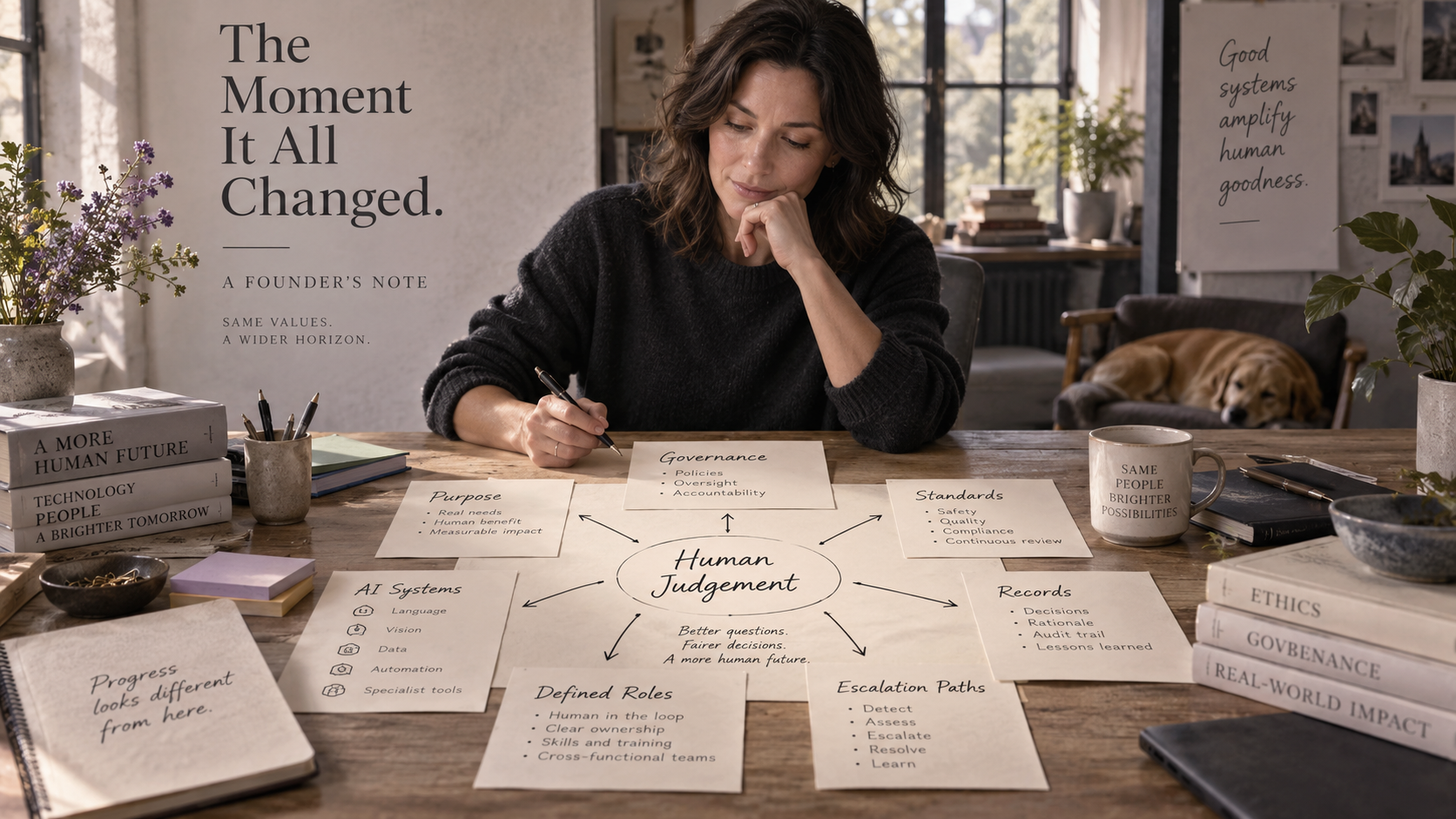
There is something happening in the AI market that genuinely concerns me. Businesses are being encouraged to move faster and faster with AI before they have asked even the simplest questions. Not the complicated questions. Not the technical questions. The simple ones. What are we actually trying to improve? What should AI be allowed to do? What should AI never be allowed to do? Who checks the output?
Who owns the decision? What happens if the AI gets it wrong? What source of truth is it using? Where does human judgement sit? Too many businesses are skipping those questions. They are jumping straight into tools, subscriptions, automations, chatbots, AI agents, AI assistants, and clever workflows because the market is telling them that speed equals progress. But speed without judgement is not progress.
It is risk moving faster. And I think a lot of SMEs are being asked to gamble with their own business without being told that is what they are doing. OSCAR exists for exactly this reason. OSCAR is not there to slow a business down for the sake of caution. It is there to stop a business doubling down on AI before it understands where AI actually belongs. Because AI can help. I believe that strongly.
AI can reduce load. AI can organise information. AI can draft. AI can spot patterns. AI can support admin. AI can help a small business create capacity it would never otherwise have. But AI can also create false confidence. It can make a weak process look efficient. It can make a business owner feel in control while the real control has quietly moved into a system no one has properly governed.
This is where it gets dangerous. The danger is not just that AI gives a wrong answer. The danger is that the business starts trusting the wrong thing, at the wrong time, for the wrong reason — and nobody notices until the cost has already landed.
I've seen this happen. A business deploys an AI Worker to handle first-response customer queries. It works well for a few weeks. Then a billing dispute comes in — the kind that needs a human to read between the lines — and the AI handles it anyway, confidently, incorrectly. The customer leaves. Nobody flagged it because nobody had defined where the AI was supposed to stop.
AI should handle volume. Humans must retain judgement. Not a slogan. That is a line in the sand. An AI Worker should not be a random chatbot with a job title. It should not be a clever prompt dressed up as a business function. It should not be allowed to quietly make decisions because everyone is impressed by how fast it works. An AI Worker should be a bounded role inside a governed operating system.
It should have limits. It should have permissions. It should have escalation rules. It should know what source of truth to use. It should know when to stop. And the business should know exactly where the human decision gate sits. This is why I keep coming back to the same point: AI adoption is not a tool problem. It is a business-governance problem.
Most businesses do not need another person telling them to “try this amazing AI tool.” They need someone to help them ask better questions before the tool gets anywhere near the business. Where is the operational pressure? Where is the commercial value? Where is the risk? Where is the human accountability? Where is the evidence? Where is the boundary? Where is the decision gate?
This is the work OSCAR is designed to do. It looks at the whole adoption picture before implementation begins. It helps identify what is ready, what is not ready, what should happen first, and what should be protected from premature automation. Because not every AI opportunity should be acted on immediately. Some things are ready for AI support. Some things need process repair first.
Some things need governance before automation. Some things must stay firmly with a human. A serious AI adoption pathway has to be honest about that. Human Heartbeat AI is built around a clear route: Diagnose. Implement. Train. Govern. Improve. OSCAR diagnoses. Execution Sprint implements the right things in the right order. The Academy helps people learn how to work with AI properly.
Governance keeps the human heartbeat in the system. I am not against AI. Far from it. I believe AI can be one of the most powerful capacity builders SMEs have ever had access to. But I am against reckless AI adoption dressed up as innovation. I am against businesses being pushed into automation before they understand the consequences.
I am against AI being allowed to drift from support into authority without anyone noticing. And I am against the idea that asking governance questions somehow means you are behind. It means you are taking the business seriously.
The businesses that win with AI will not simply be the ones that move fastest. They will be the ones that know what should move fast, what should move carefully, and what should never move without human judgement. We are holding that line. AI can support the work. AI can reduce the load. AI can increase capacity.
But the business still needs to know who decides, who checks, who owns the outcome, and what must never be handed over silently. That is the Human Heartbeat. And that is why OSCAR comes first.
Pass the argument to someone who should be part of it.
Continue through the Founder Notes series.